Take advantage of FutureVault’s technological breakthroughs to build an efficient and secure document management portal that will prove highly effective now and long after COVID-19 fades away
The COVID-19 Novel Coronavirus has caused over 500,000 infections and claimed more than 23,000 lives around the world. It’s a global pandemic and a major public health threat that’s growing rapidly in many countries, especially in the United States.
The good news is that there are proven ways to protect yourself against the effects of COVID-19. Staying home and avoiding close contact with others in the rare instance you have to leave home offers a strong defense against infection. And when it comes to the business-damaging effects of COVID-19, there are effective ways to fight back too.
Major advances in tech innovation over the past few years now give you the ability to offer financial planning, insurance, and tax advice and handle clients’ needs from the comfort of the financial advisor’s home. Those advances came not a moment too soon. With financial markets showing extreme volatility, many, if not all, financial wealth clients are more anxious now than they’ve ever been.
Rather than fretting over the lack of face-to-face meetings, you can take advantage of these technological breakthroughs to build an efficient and secure document management portal that will prove highly effective both now and long after COVID-19 fades away.
Why a digital vault platform powered by FutureVault is the most important tech innovation to date that will help you continue to help your clients as you work from home:
Digital Vaults
A digital vault is essentially an online safety-deposit box. It stores your clients’ financial information, providing airtight security against potential scammers and hackers, but also fast and easy access for advisors, trusted professionals, and clients, no matter where in the world they’re located.
Those are indispensable benefits in the age of social distancing. As more countries and cities go into lockdown, financial advisors are being forced to work from home, and clients are finding it harder and harder to meet with them face-to-face.
FutureVault leads the digital vault space. FutureVault’s cloud-based digital vault technology gives financial advisors the convenient, secure, digital document management platform they need. Powered by AI, leveraging private LLMs, and our Intelligent Document Processing engine, FutureVault enables you to manage all of your clients’ vital documents, quickly and easily.
FutureVault: An Official DocuSign Partner
Forcing face-to-face meetings to sign documents was already an antiquated way to do business before COVID-19 came along. Now, electronic signing platforms are surging right past tools of convenience to tools of necessity.
FutureVault offers an integrated electronic signing platform with DocuSign, a leading e-signature provider. Clients concerned about information security and document storage when using e-signatures can rest easy, knowing that FutureVault’s security features and DocuSign’s easy-to-use platform combine to make clients’ lives much easier at signing time.
Even if your client base skews, older, quick, and secure communication is becoming a highly desired tool for investors, both young and old, as part of a broader digital approach to wealth management. A 2017 CFA Institute report found that nearly 40% of investment advisor clients over the age of 55 considered robust digital client offerings as an essential tool in how they want to interact with their advisors. Given the tech advances that have happened since then and the current social distancing movement that prevents those clients from meeting in person, it’s a sure bet that such a study would produce far higher numbers today.
FutureVault’s Advanced Digital Tools
FutureVault features a wide array of other digital tools that offer many benefits for advisors forced into remote work; many of those benefits will carry over long after lock-downs have ended.
FutureVault’s AI-powered search platform enables both advisors and clients to quickly and easily access documents from anywhere, anytime. Its automated checklist feature makes time and task management easier than it’s ever been. FutureVault’s checklists also automate document tasks, saving companies time and money.
FutureVault’s Global Folders feature ensures that corporate documents, onboarding forms, and other vital items once tendered in the form of stacks of papers are now digitally secure and up to date. Global Folders also helps ensure that the most important corporate documents are easily accessible to the whole organization digitally, while greatly reducing the amount of paper waste you use, which in turn lowers your carbon footprint — a worthwhile goal in any climate.
Digitization as a Service (DaaS) FutureVault and Iron Mountain Bridge the Digital Physical Divide
Iron Mountain brings the world’s leading logistical network and physical information solution that protects documents by combining security, real-time tracking, and an auditable chain of custody for physical information protection. Those features add to FutureVault’s encrypted document management platform to offer one virtual point of collaboration, helping companies build their own digital transformation strategies.
Add in FutureVault’s ability to keep advanced activity-tracking logs and complete fiduciary audit trails to ensure compliance, and you have an all-in-one solution. One that’s tailor-made to help your team to continue to work seamlessly at a time when less prepared businesses are scrambling trying to find secure solutions.
Even when advisors are able to return to corporate offices, societal changes will likely make remote financial advising an increasingly popular option for clients and advisors alike. FutureVault will help your organization adjust and thrive in that new market reality.
There is no question the face of finance is changing. From how we interact with institutions to the level of service we expect to the fees we are willing to pay, the world of wealth management is facing disruption. Millennials, the Amazon Prime Generation, is the driving factor, but those ‘O.K. Boomer’s’ and Gen Xers control more wealth and are living longer lives. For financial service firms to remain successful in the years to come, they must implement a multi-generational digital strategy that is high-tech and high-touch
Millennials and the great wealth transfer
We hear a tremendous amount of buzz about Millennials and the impending great wealth transfer, where they will inherit trillions of dollars. Millennials have been instrumental in driving digital adoption, having been the first full digital native generation, and retail marketers are doubling down on them. A 2018 study by RetailMeNot conducted by Kelton Research found that retailers surveyed reported increased budgets targeted at younger generations. Approximately two-thirds of respondents said they are increasing their marketing spend targeting Gen Z (65%) and Millennials (68%).
For businesses that want to retain and attract Millennials, this translates into more apps and automated services that streamline processes, are less time consuming, require less face-to-face time and fewer phone calls.
Baby Boomers and Gen X control more wealth
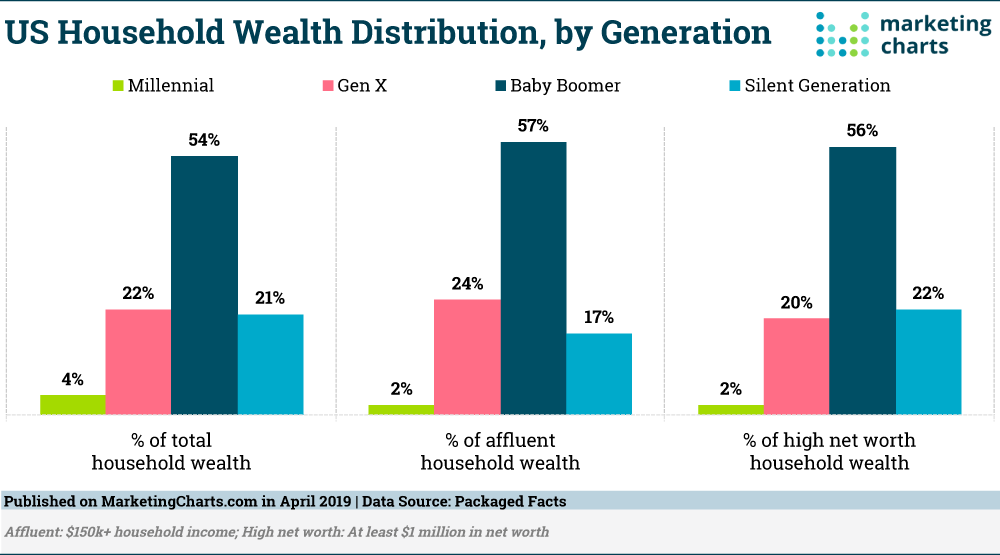
However, a new report by Packaged Facts states Baby Boomers control more than half of all (54%) of all of U.S. household wealth, followed by Generation X at 22%. Focusing a marketing strategy on just Millennials may be short-sighted. According to the U.S. Census Bureau, in 2029, there will still be an estimated 61 million Baby Boomers worth an estimated $26 trillion, and Gen Xers will hold an estimated 22 trillion by 2030.
U.S. Household Wealth by Generation — Marketingcharts.com April 2019 Data Source: Packaged Facts
The good news is that research is finding the generations are more similar than we may think. Even though Millennials are the clear catalysts when it comes to technological adoption, there is ample evidence that older generations are also embracing it.
Yes, that O.K. Boomer may also be digital-savvy.
According to Pew Research, 2019, there has been a tremendous increase in tech adoption since 2012 among older generations — particularly Gen Xers and Baby Boomers. The report found more than nine in ten Millennials (93% of those who turn ages 23 to 38 in 2019) own smartphones, compared with 90% of Gen Xers (those ages 39 to 54 this year), 68% of Baby Boomers (ages 55 to 73) and 40% of the Silent Generation (74 to 91).
One-third of clients plan to switch wealth management providers over the next three years. Firms need to act now to retain and attract clients. — EY 2019 Global Wealth Research Report
Clients, regardless of generation, want transparency, flexibility, seamless communication, digital access, and education, and thanks to emerging technology, it is not hard nor complicated to deliver on all fronts. Wealth management firms can implement a multi-generational strategy while addressing rising administration and compliance costs.
Digital Vaults — Empowering the financial advisor of the future
Technology inundates our lives, supposedly to simplify it. Yet with each new app, it seems like life is getting more complicated. For businesses that rely on secure, paper-heavy processes, the ability to collaborate and communicate around these actions is incredibly important. A good majority of business document procedures are not safe or seamless. A lot of our personal information is in email, in filing cabinets, on various computers, and on hard drives. It’s everywhere.
A recent survey from data protection research firm Ponemon Institute and Shred-It found that 68% of surveyed companies reported a data breach of confidential documents within the year. The majority of these data breaches involved the loss of paper documents or an electronic device.
The demand to have all of our essential information in one secure place is driving the digital vault revolution. A Digital Vault, a cloud-based Document Management System (DMS) on steroids, is an incredibly valuable tool for the future of wealth management and other industries. The challenges faced by businesses to transition to paperless offices, rising administration, and compliance costs combined with the increasing demand for end-to-end digital workflow solutions are solvable with the implementation of a digital vault platform. In addition to fiscal and operational improvements, a digital vault can help ingratiate a brand into the mind space of current and future clients.
Companies like FutureVault, provide wealth management firms with unique document collaboration platforms that offer pro-active businesses the opportunity to become the digital hub in their client’s lives. A brand awareness that goes beyond the client, to family members, and other external, trusted advisors just by its sheer utility. The opportunity for financial services providers to add this additional layer of value to their clients is driving an industry expected to see a Compound Annual Growth Rate (CAGR) of 13.6% through 2023.
“In the same way that a bank has traditionally been the protection of peoples’ financial assets,” says Jeremy Balkin, head of innovation at HSBC US and multi-award-winning author (Investing with Impact: Why Finance is a Force for Good and Millennialization of Everything), at the recent Money 2020 Conference in Las Vegas. “Who is to say that a bank in the 21st century won’t be the protection or the vault for peoples’ personal data assets. I don’t think that is beyond the realm of possibility.”
Objections to implementing new technology can be overcome by adopting the right solution. Digital vaults are technological enablers. User-friendly interfaces ensure that even the least tech-savvy, regardless of the generation gap, can benefit from digital vault solutions. Everyone in the value chain benefits from having one central point of secure collaboration around important information, be it financial advisors, trusted professionals, educators, and family members.
Robo Advisors — friend or foe?
The rapid advancement of technology is reshaping how financial advisors and clients interact and make decisions. Robo Advisors, computer programs utilizing artificial intelligence & machine learning, offer investment advice and portfolio management at a low cost with little human interaction. As these computer programs get better and better the concern is that one day they will completely replace human advisors.
Robots are great for automated investment services, able to automatically buy and sell assets and rebalance portfolios at a low cost. Human advisors are great at helping clients diagnose financial challenges and opportunities based on life circumstances and not algorithms. Utilizing Robo Advisors for portfolio management frees up financial advisors for the high-touch point interactions clients are seeking.
It’s hard to say at this point the real impact Robo Advisors will have on the wealth management firm, but many believe they will be ‘friend’ instead of ‘foe’ — a valuable tool to remain competitive in the coming years.
The hybrid financial advisor
42% of surveyed clients want face-to-face interactions with their advisors, according to E.Y.’s 2019 Global Wealth Management Report. Even though these clients wish to have digital access to information, KYC, and trade confirmations, they still want the human touch when it comes to financial advice around significant life changes and overall financial planning.
The technological revolution or ‘disruption’ will come as firms utilize Robo Advisor services to portfolio management and back-office automation, allowing the financial advisor to focus on the client-advisor relationship.
Institutional-grade cryptocurrency tools for the millennial investor
Millennials are disrupting the alternative investment categories like real estate funds and other non-traditional investments like cryptocurrencies.
A recent study from Global Communications Marketing firm Edelman found 25% of affluent millennials use and or hold crypto (24 to 38 yrs. who have at least $50,000 in investable assets or $100,000 in individual or joint income).
Cryptocurrencies are preferred among American millennials 3X more as long-term investments as they are for Generation X. A Bankrate survey from July 2019 found 9% of millennials chose crypto as their top long-term investment option. Another 2019 study conducted by eToro, a social trading and multi-asset brokerage company, found millennials are leading the shift to cryptocurrency investments.
● 43% of millennial online traders say they have more faith in crypto than in the stock market
● 71% of millennials would invest in crypto if offered by traditional financial institutions
● Half of the online investors expressed interest in a crypto allocation in their 401k (pension) plans
One thing is clear, to satisfy the expectations of current wealth holders while attracting or retaining Millennials, wealth management providers will have to be agile and have the marketing, and IT resources to pivot quickly as market conditions change.
Times change. Twenty years ago, the idea of working from home was almost unheard of in wealth management, with most finance professionals preferring the traditional face-to-face model. Changing times and as of late concerns over the coronavirus, financial advisors more than ever are choosing to work remotely.
That shift will only accelerate a trend that’s been increasing over the past few years. A 2018 study found that 70% of professionals worldwide work from home at least once a week. More recent numbers underscore that trend. According to a recent Gallup poll, 43% of employed Americans spend at least some time working from home. Within that group, 31% of professionals who work at least some of the time remotely spend four or five days a week out of the office.
Societal changes also have a way of sticking. Combine an organic upswing in remote financial advisors with the vast army of young freelancers and the widespread changes happening due to the coronavirus, and many companies might decide not to go back to the old ways. It’s thus likely that we’ll see a more significant percentage of professionals working from home more often than once a week, up to and including full-time.
Health concerns aside, remote work offers numerous benefits for financial advisors. First, it eliminates commuting time, giving you more time to focus on the projects at hand. Second, it offers a more flexible lifestyle. When you’re not in an office for eight hours a day or more, you can focus on work and also other elements of your life that matter to you. Though many wealth management professionals are still inclined to believe the client suffers from a lack of in-person meetings, the opposite could hold true. Remote financial advisors can be more productive, and less time on the road means more time with clients via video conferencing software.
Digital Vaults help the transition to remote work for financial advisors effortlessly.
Today, the wide array of readily available digital tools for financial advisors makes working remotely easy, or at least easier than it’s ever been. From CRMs and Portfolio Management tools, the various communication tools make collaboration seamless. Equally as important for the back office, front office, and clients alike, is having an accessible, centralized, and secure platform to manage information and important documents—a Digital Vault.
A Digital Vault works like an online safety deposit box. It allows you to access and manage corporate messaging, advisor and front office communications, and your client’s important information. As befitting its name, a Digital Vault provides airtight security for your client’s documents.
That’s music to the ears of financial advisors.
With Digital Vault technology, there’s no need to be in the office to handle your clients’ vital information, since it’s already securely stored in one central platform, accessible at any time and from anywhere.
In addition to the security and convenience offered by Digital Vaults, they also make it far easier to organize, manage, and find the documents you need, often in just seconds. Digital Vaults are powerful collaborative tools powered by AI and machine learning that allow you to manage all of your clients’ vital documents, quickly and easily.
FutureVault, the industry-leading Digital Vault, provides institutions and financial service providers with the convenient, secure, digital document management platform they need. FutureVault offers powerful automated workflows through e-signature and DocuSign integrations, an automated checklist feature, and an AI-powered search platform, all of which combine to make remote collaboration for the wealth management professional a breeze.
Know with confidence that your financial advisors are armed with the latest digital collaboration tools.
Enhance your clients’ security perimeter: Move digital documents from email attachments, personal hardware, and less structured online storage locations to one securely encrypted Digital Vault.
Quickly search and retrieve documents: Easily search, retrieve, and share documents with FutureVault’s advanced OCR and indexing algorithms.
Improve document workflows: Speed up business processes, improve workflow collaboration, and get signatures anytime and anywhere with FutureVault’s official electronic signature partner DocuSign.
Simplify document intake: Create and manage digital document checklists and improve efficiencies around specific business outcomes through automation with FutureVault’s Dynamic Checklist feature.
Centralize corporate communications: Ensure all corporate documents, onboarding forms, how-to guides, and templates for your team are up to date, centrally located, and easily accessible via the cloud with FutureVault’s Global Folders feature.
Better compliance risk: Track all activities by all VaultHolders & Trusted Advisors in real-time in your clients’ Digital Vaults with advanced activity-tracking logs and complete fiduciary audit trails.
Reduce your carbon footprint: Lower your energy demands and cut costs associated with legacy paper processes and take advantage of the greenness of the cloud with FutureVault, the future of information management.
While the industry radically shifts toward progressive digital transformation, there are still some roadblocks in place. Below are four primary reasons holding wealth management firms and advisors back from digitization.
There’s a tug-of-war going on inside the wealth management industry. Cutting-edge technology has become widely available for wealth managers in the past few years. They’re just divided on whether or not to use it.
First, many older high-net-worth-individual clients don’t quite see the need for digitization; in many cases, they’re actually pushing against it. That in turn makes those clients’ money managers reluctant to make big, sudden changes.
Second, risk aversion is woven into the DNA of wealth managers, a logical stance to take given the stakes involved in managing millions (or even hundreds of millions) of dollars. Making any big change to the way they do business can thus cause trepidation.
Third, abandoning legacy systems for new forms of technology is usually very costly, and many wealth managers focus more on the challenges they face today, rather than tomorrow.
Finally, the financial industry deals with more regulation than virtually any other sector. Making any major change can raise the suspicion of regulators, something wealth managers obviously don’t want to do.
These are all reasonable arguments for moving slowly to make dramatic changes. Nonetheless, the reasons in favor of digitization outweigh those against it. Wealth management firms and advisors who go all in and commit to digitization gain benefits ranging from greater efficiency to lower operating costs, increased customer satisfaction to higher revenue.
Some of the most important emerging technologies that are changing the wealth management industry are blockchain, artificial intelligence/machine learning, and the cloud.
It all starts in the cloud. A great document management system is vital. Arguably, the most robust document management system is the digital vault. Digital vaults provide a secure environment in which to store, manage, and transfer documents. A highly intelligent document management tool that goes well beyond storage.
These cloud-based document management systems offer a new and innovative way for wealth managers to grow their business, completely independent of how effective they are at picking stocks or guiding retirement plans. By ditching legacy paper-based filing in favor of digital vaults, wealth managers save time, save money, greatly improve their security capability, and entice forward-thinking clients who demand increased digitization.
Digital vaults aren’t propelled by cloud technology alone. Artificial intelligence and machine learning are also integrated into digital vaults. That ability to strip human error out of document storage and retrieval systems is what makes digital vaults the wave of the future. Offering the security of a safety deposit box, digital vaults make accessing and managing financial documents fast and easy, from anywhere in the world, at any time.
A transformative digital vault is inter-operable with CRMs/ERPs/ECMs and acts as the central hub around digital communications. It’s one of many ways that digitization is driving new business for wealth managers.
Blockchain’s uses for wealth managers are manifold. The smart contracts generated by blockchain can make risk management, data privacy protection, know your client (KYC), and other functionalities cheaper and simpler than ever before.
Another important client service being improved by digitization is the process of client onboarding. In an effort to meet the needs of increasingly mobile clients, one European wealth manager launched a service that allows clients to open accounts via videoconference. Remember the stacks of paper you used to have to sign when opening an investment account? Electronic signatures are rapidly upending that process. Add in time-saving mechanisms such as online ID verification and biometric authentication, and you have a set of new, fast, secure ways to get clients set up and ready to trade.
Wealth managers looking to drive sales are likewise finding new solutions via advances in technology. Customer relationship management software has improved by leaps and bounds in the past few years, with tablet-based CRM apps turning the formerly dense, arcane sales process into a task easily handled by a single platform.
Fulfillment and trading have become seamless thanks to technology. Moreover, a growing number of wealth managers have built digital platforms that allow customers to trade stocks and funds online and engage in a social marketplace where vendors and clients can communicate instantly with each other, and among themselves.
Finally, robo-advisors offer financial advice and investment management services through the use of algorithms, with very little intervention from human beings. That technology has become especially popular with younger investors.
An Ernst & Young study found that 61% of the clients aged 18 to 34 that they surveyed would likely consider robo-advisors, compared to 51% of 35-to-50-year-olds and just 24% of respondents aged 51 to 71. Wealth also proved to be a strong predictor of robo-advisor interest, with 70% of high-net-worth individuals surveyed saying they would consider robo-advice.
But what of the perceived risks of going digital? The risk of not doing so simply looms larger.
It’s only a matter of time before the older high-net-worth individuals who resist digitization pass their wealth onto younger generations who grew up in a digital world. The Ernst & Young study found that 59% of wealth management clients will want to use digital channels to receive investment advice in the next two to three years. The reasons for those responses include increased security, increased speed, and improved ease of use offered by automated systems.
Worrying about the cost and risk of upgrading legacy systems thus gets trumped by the cost and risk of wealth managers losing business to competitors if they’re too slow to adapt. As for regulators potentially gumming up the works, here too it’s only a matter of time before regulators recognize the vastly superior security capabilities of digital vaults and make those vaults the new industry norm.
In this new era of increasingly digitized wealth management, wealth management companies thus have two choices: Build the technological tools to meet changing customer demand, or partner with fintech companies that are building innovative business-to-business solutions to meet that same demand.
Option number three is to try to keep doing business the old way. Given how quickly the wealth management industry is evolving, option number three soon won’t be much of an option at all.
And remember, it all starts in the cloud.
Increasing demands are pushing those in legacy systems to rethink the customer experience and, as a result, are integrating cloud solutions that facilitate encrypted document sharing between clients, advisors, and other professionals.
Digital Vaults are a cloud-based platform that provides an encrypted repository for users to store, share and collaborate important business and personal documents, such as wills, deeds, estate plans, financial statements, and tax filings with their Financial Advisers, Lawyers, Accountants, and other trusted professionals. These centralized cloud-based solutions offer not only additional layers of safety for relevant information but a way to reduce costs while increasing communication channels with clients.
A recent report by PwC’s Retail Banking indicates a growing awareness of the need to develop a more customer-centric business model, but an incredibly large gap in preparedness remains.
61% of bank executives say that a customer-centric model is “very important”.
Global online collaboration market is expected to increase by 9% in 2019 to go beyond US$45 billion. (Synergy Research Group)
Collaboration technology in business is rapidly changing how we work and how we communicate with clients. A report by McKinsey points to a 20–30% increase in productivity occurs with online collaboration tools and digital workplaces (McKinsey). Yet according to another report, 83% of workers depend on technology to collaborate, but 59% face challenges with their organization’s current tools (Alfresco).
Industry leaders like FutureVault realized they could help financial institutions and professional services substantially increase collaboration and accelerate document-heavy processes that require many steps and include several stakeholder touchpoints all from one platform.
Key features and benefits of FutureVault’s encrypted collaboration platform include:
Accelerate KYC, client onboarding, and account opening processes and procedures.
Drive productivity by introducing new, secure, and innovative ways for businesses to collaborate with their customers, and trusted advisers.
Improve the customer experience by offering them the ability to manage their personal and business information in one secure digital vault accessible to them anytime, anywhere across multiple devices.
Innovative features:
Document upload and access across various digital assets, including mobile or web including upload via mobile phone photo.
Fiduciary Audit trails and permissioning capabilities to monitor, control and adhere to critical compliance requirements.
Real-time notifications when content is uploaded for both clients and advisers.
Smart, suggestive auto-filing of digital documents to drive operational efficiency.
Interactive commentary to enhance client and adviser document collaboration.
Bulk physical digitization of documents leveraging physical document management with digital.
Workflow accelerators like checklists to enhance customer experiences and drive productivity.
Why are banks leveraging digital vaults?
One in three millennials in the United States are open to switching banks in the next 90 days and a similar proportion believe they will not even need a bank in the future. Source: Viacom Media Networks — The Millennial Disruption Index
Focusing on the customer experience may be the single most critical investment, a financial institution or professional business can make in today’s competitive climate. Integrating a client-facing digital collaborative vault will keep their brand front of mind with their clients and set a new standard for delivering client excellence.
Banks are a natural fit for digital vaults.
Jim Marous, co-publisher of The Financial Brand and publisher of the Digital Banking Report, in the article The Bank of the Future Will Have Data Vaults and Money Vaults, interviews Hossein Rahnama, CEO and Co-Founder of Flybits, on the role banks will play with big data. Banks are in the best position to be the data vaults of the future. There is a deep trust there that does not exist elsewhere among large corporations.
“I definitely see that banks are in a perfect position, if they innovate right, to be the perfect data vaults for the future — managing the privacy and also the data of their customers,” says Hossein Rahnama, CEO and Co-Founder of Flybits.
The US Department of Defense is experimenting with blockchain technology as a possible cybersecurity solution.
“The Defense Advanced Research Projects Agency (DARPA) is starting to experiment with blockchain to create a more efficient, robust, and secure platform using a blockchain protocol that will allow personnel from anywhere to transmit secure messages or process transactions that can be traced through numerous channels of a decentralized ledger. The application will be used in different ways, including facilitating communication between units and headquarters, and transmitting information between intelligence officers and the Pentagon. DARPA also has been trying to develop an unhackable code — which blockchain could facilitate — because the technology offers intelligence on hackers who try to break into secure databases.” — DoD Digital Modernization Strategy: DoD Information Resource Management Strategic Plan
Blockchain is a Distributed Ledger Technology (DLT) that is decentralized; information is available to all nodes (computers) on a specific blockchain, and everyone in the network has a copy of the whole database. All transactions are encrypted and stored in blocks that are time-stamped and linked together chronologically. If a change is mad,e you can’t rewrite a block. The change is stored in a new block and time-stamped. This process creates trust while also maintaining a high level of data integrity.
The sending and storing of important data in a decentralized database like Blockchain solves a critical issue of a centralized database that has a single, vulnerable point of access, which makes it easier to hack. Data stored on a blockchain has no single point of attack for hackers. Blockchain’s transparent record-keeping system gives each node information on any potential hack attempts in real-time. Blockchain takes information, encrypts it, breaks it up into small chunks, and distributes it across the network If the info is hacked the hacker only gets a piece of the encrypted data.
Blockchain could ultimately be an integral piece for information management across many industries including cloud computing.
The FutureVault platform is a natural fit for a blockchain-powered document and transaction authentication service.
“Many companies are driven to be part of the blockchain technology trend and are looking for ways to duct tape it onto their products. However, the FutureVault platform is a natural fit for a blockchain-powered document and transaction authentication service. Having the ecosystem already in place, document storage, document collaboration, security, and relations with institutions with the need to authenticate documents. Acting as the platform for an authenticated document escrow service is a natural fit.” — Brad Rosenberg, Co-founder at FutureVault
Blockchain adoption seems to be taking off; in a few years, it will no longer be considered ‘emerging’ or ‘disruptive.’ Laymen will be able to differentiate blockchain technology from Bitcoin, the cryptocurrency that helped launch blockchain to fame.
As businesses produce more and more data and a mountain of documents, they’ll need to learn to analyze, manage, manipulate and monetize all of that knowledge.
Now, technical help is on the way. IT operations guru Tony Lock writes in ComputerWeekly.com that technology is finally enabling explorative data analysis and the visualization of information in useful ways: “We are at the start of an era when finding data, and using human insight to turn it into valuable information on demand, should become routine.”
Lock writes that firms are starting to undertake a process of data discovery to better manage their content and information. That now includes not just the files that they are legally required by regulators to monitor, but also other files that until recently were effectively lost from analysis because of the random ways that staff have filed them across disparate systems.
Regulations such as Europe’s General Data Protection Regulation — which comes into effect in May with the goal of strengthening data protection for individuals — is prompting a growing number of companies to look more deeply into how they manage information throughout their businesses to maximize its value, Lock says.
Data produced by businesses is growing at an incredible pace: Today, the world produces 2.5 quintillion bytes every day, and 90% of all existing data was created in the last two years. As businesses seek new ways to manage all these files and figure out ways to profit from all that information, Gartner estimates that global revenues from the business intelligence (BI) and analytics software will grow to $22.8 billion by 2020.
Why do businesses need to manipulate their data? BI Survey explains: “Data is commonly seen as the oil of the future providing high value for innovation and success. This new data-driven approach aims to go beyond mere reporting and monitoring of the organization’s performance, which has been the core of traditional BI initiatives. The goal is to exploit the full value of data to not only improve decision-making but to directly impact the optimization of business processes and to fuel new business models.”
Getting the most from data requires software that is easy to use, provides visual dashboards, is agile and flexible, produces insights faster and can handle a large (and growing) amount of data. As a growing number of tools are capable of doing all those things, Lock writes, “The age of enterprise-wide information management may finally be dawning.”
Paper has long been the bane of the financial services industry. Back in 1968, Wall Street suffered its infamous “paperwork crisis” as processing daily trading volumes of 12 million shares almost drowned the entire industry in paper. The paperwork was so overwhelming that the New York Stock Exchange restricted trading to four days a week to give brokers time to clear the massive backlog of paper trades. A few years later, a 1975 article in Business Week promised that we would have the “paperless office” by the mid-1990s. However, anyone who has ever signed for a mortgage or a loan knows we still have a considerable way to go.
The good news is that the average business creates 90% of its information electronically, but unfortunately still retains 10% on paper, soaking up significant business resources. The costs associated with retaining those paper records are sobering: An office of 100 people will spend $16,800 to cover the 84 four-drawer vertical file cabinets that house their records, according to Iron Mountain. The rent for that space will cost another $20,000. Making matters worse, losing important paper-based records results in significant lost productivity, amounting to $14,000 per worker annually as staff search for a needle in a haystack.
Today, only 12-15% of bills and statements are delivered electronically, raising the question of why paper is such a stubborn part of the financial services industry. “Consumers choose what is easiest and best for them. That means that companies that want to drive digital adoption must understand why customers like paper and then invest in technology that aligns with what the consumer wants,” Broadridge Chief Executive Rich Daly writes in Forbes. “When you want to innovate, it’s not enough to make things simpler; you must make things better.”
Many times when businesses try to embrace the paperless office and move to digital document storage, they bring their old bad habits with them. Wired magazine writes, “Often, companies have just shifted their filing system from the paper version to digital form and are still suffering from the same drags on productivity. We’re still … trying to find a document buried in a chaotic mess of folders.”
Daly says that financial services companies that want their customers to transition to digital, must connect with customers where they are. For example, if a customer uses a digital vault to store their financial records, firms should deliver correspondence and statements there to boost digital adoption. In addition, consumers will only switch to digital when the electronic experience is easier than the paper experience and also brings new benefits.
Imagine you had a solution that could analyze documents as they are stored and file that information in the correct location, like a built-in librarian? Imagine being able to produce a quick summary form that can send reminders about important events? Or a system that can also make recommendations about what documents are related, so that they can be stored in a structured taxonomy. When it comes to storing business records, digital technology can go well beyond the capabilities of paper.
Is it time for your office to go paperless?
As financial services companies invest in improving their digital offering, it is vital that they appeal to millennials who grew up as digital natives. Having a killer digital offering is no longer a luxury as millennials and the younger digital native generations are in the midst of overtaking baby boomers as the largest living adult generation, according to U.S. Census Bureau forecasts, making them the most crucial audience for any financial services firm.
That’s no easy task: Millennials can be a tough bunch to please — 71% would rather go to the dentist than hear a message from a bank — but following these five steps will help engage these important customers.
Build a Great Mobile Application
Having a great mobile app helps financial services firms, from banks to wealth managers, to connect with millennials. A FICO Survey reveals that 30% of millennials use their bank’s mobile app daily, and 66% use it several times each week. However, when millennials don’t like your app, they go elsewhere — one-quarter of them have switched their primary checking account to access a better banking app. Experian Data Analytics writes, “Millennials were raised in the digital age; therefore, mobile devices are the hubs of their digital lives. They expect real-time access to their accounts for peer-to-peer payments, deposits, paying bills and customer service. Millennials have proven most likely to switch financial services providers to gain access to more robust mobile banking services.” Bank of America reports that among its customers, millennial households are twice as likely as others to use their mobile devices to do such things as pay bills and deposit checks.
Be Secure
Visa reports that 78% of millennials prioritize safety and security features and that they appreciate such features as account alerts and two-way text fraud alerts. Robust security is considered essential to the trust that millennials want in their financial institutions.
Offer Control
Millennials love tools that help them budget, plan their finances, save for the future, gain financial education and exert greater control over their financial wellbeing. The popularity of apps such as Venmo, Digit and Robinhood highlight the type of innovative features that financial services firms should try to include in their offerings to delight millennials who like such things as budgeting tools and commission-free stock trades. Millennials are all about control and feeling like they’ll be well on their way from 5-figures to 6-figures in no time.
Be Problem-Free
Any digital offering should include ways to resolve the critical problems that frustrate customers. The Financial Brand writes that the four biggest problems millennials have with their banks are difficulty resolving problems, (57%) standing in long lines, (37%) technology failures (33%), and the inability to carry out a transaction online (29%.) All those problems can be resolved with a great digital experience.
Be Authentic
Even when a financial services firm has a great digital experience, millennials respond best to firms that have an authentic marketing message. Experian writes, “Millennials hold businesses, especially banks, to a high standard. They want to see a path to their hopes and dreams in the conversations banks start, whether on social media, via email, or through paid advertising. Marketing messages should sound less like marketing and more like a guide to help them achieve their financial dreams.” Indeed, 70% of millennials will spend more on brands that support the causes they care about, according to Omnicom Group’s Cone Communications.
Digital estate planning after a loved one passes away has received growing attention in media and blogs, offering tips about what people should do to safeguard their digital assets — from their Facebook presence and digital files to a digital map of their financial assets.
Wealth Adviser writes that people should make handling digital assets part of their overall estate planning, suggesting a four-step process; 1) conduct a digital “fire drill” to identify important or valuable digital information, 2) take an inventory of those digital assets and find a place to secure that information, 3) back up your data, and 4) put your digital estate plan in writing.
Having access to our digital assets after our death is recognized as an important legal issue. The National Conference of Commissioners on Uniform Laws has developed a law allowing the executor of a will to access emails and social media profiles associated with an estate — a law that has been adopted by 39 states and is being considered by seven more. But an executor really needs more access than that basic information.
“By engaging in some simple estate planning, you can protect your privacy as well as ease the management of your estate after your death,” Natalie Banta, an Associate Professor of Law at Drake University writes. “Plan for your digital assets in the same way you would any other valuable tangible or intangible asset. After all, digital assets are today’s shoeboxes of photos, letters, and other mementos. Planning can preserve your legacy in its digital form.”
Central to that process is finding a place to store and organize digital information securely. Preferably that’s someplace more secure than a shoebox. The importance of managing a digital estate goes well beyond managing such things as emails, photos, and social media profiles: People that have well-organized digital vaults can use those repositories to manage their overall estate. Imagine if an executor was granted a key to a digital vault with bank-level encryption that stores plans for the disposition and management of estate assets, making life easier for heirs.
Lawyer John Goralka writes on Kiplinger, “Your estate plan should be designed to make the administration process as easy as possible for your loved ones. This includes making it convenient to manage your assets upon your incapacity or death and saving them the hassle of sorting through your paperwork to collect assets and pay your bills. Without specific provisions in your estate plan and careful planning, access to this critical information can become difficult for your family or loved ones.” A key part of that, Goralka says, is setting up an online vault.
Setting up a digital estate goes well beyond security and peace of mind. It also gives patrons a venue to express exactly how they would like their estate managed after their death. The owner can use that vault not just to set out all the details of the estate, from financial plans to a person’s social media profiles, but can also write such things as a Mission Statement setting out the preferred values, ethics, and investment approach that the owner would like.