

A Digital Vault is a secure digital environment used to store, organize, manage, share and protect important documents, data and information.
Think of it as the digital equivalent of a safety deposit box—but built to do far more than simply store files.
For financial services organizations, Digital Vault technology can provide a secure information and document infrastructure connecting the enterprise, advisors, clients, households and Trusted Advisors within one governed environment.
Modern Digital Vault platforms can help firms:
- Centralize enterprise, advisor and client documents
- Securely exchange sensitive information
- Automate document delivery and aggregation
- Control access through granular roles and permissions
- Meet document retention and compliance requirements
- Connect documents with downstream workflows and applications
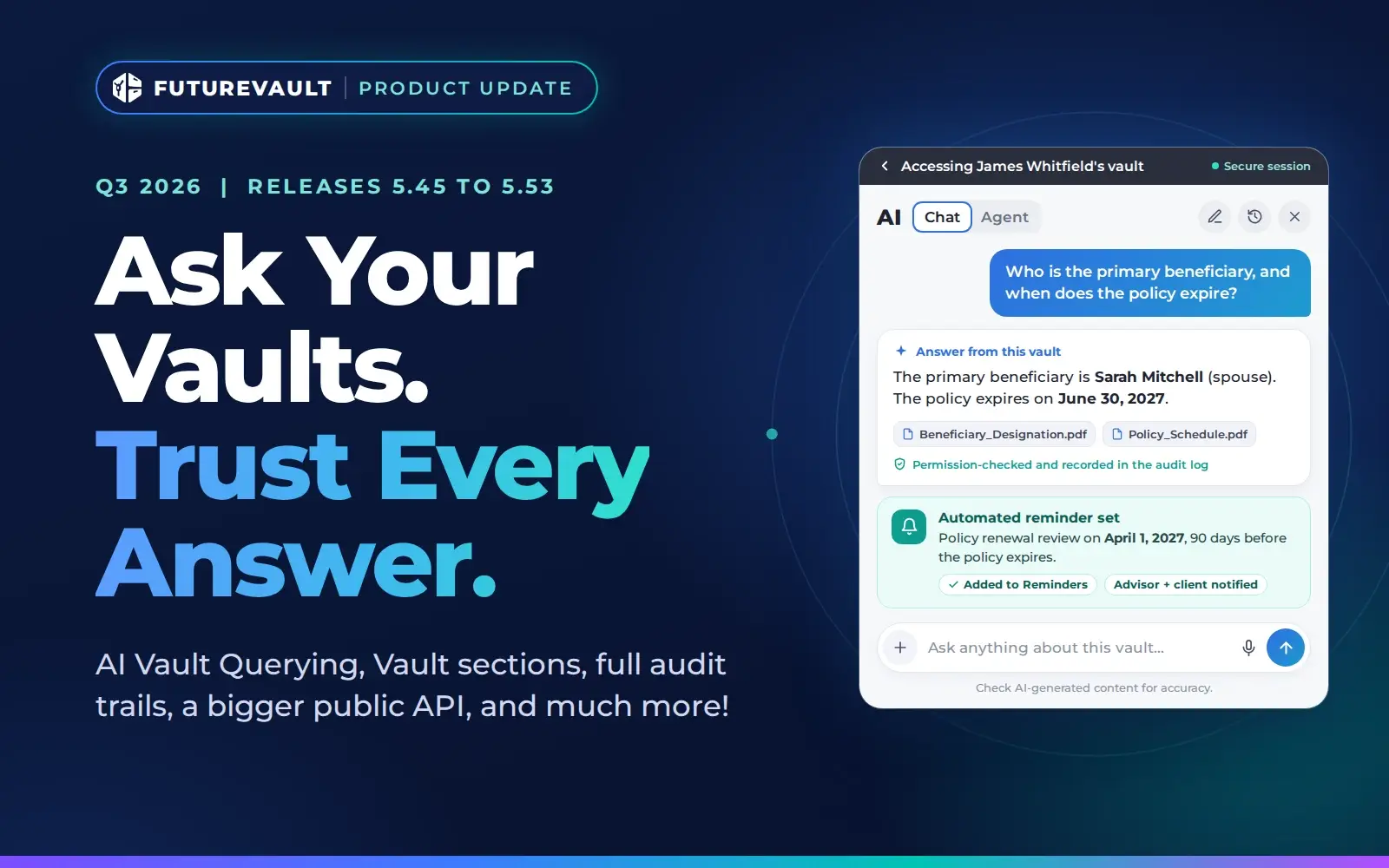
- Apply Intelligent Document Processing and AI to extract information
- Give clients and their families a persistent digital repository for important records
For wealth management firms, investment dealers, banks, credit unions, family offices and other regulated organizations, a Digital Vault can therefore become much more than secure storage.
It can become the document and information layer underpinning operations, compliance, client service and AI.
What Is a Digital Vault?
A Digital Vault is a purpose-built digital repository used to securely store, organize, manage and share important documents, data and information.
Much like a physical vault protects valuable physical assets, a Digital Vault protects valuable digital assets.
These can include:
- Financial statements
- Investment documents
- Tax records
- Wills and trusts
- Estate-planning documents
- Insurance policies
- Identification
- Banking information
- Property records
- Legal agreements
- Business records
- Client correspondence
- Compliance documentation
But the important distinction is that a Digital Vault is not simply another folder in the cloud.
An advanced Digital Vault can provide a structured environment where documents can be automatically delivered, categorized, searched, governed and made available to the appropriate users based on their role and permissions.
Within financial services, this creates a secure connection between the back office, advisors, clients and the wider household.
How Does a Digital Vault Work?
A Digital Vault creates a secure, organized environment for information that would otherwise be fragmented across email inboxes, local drives, shared folders, client portals and third-party systems.
A typical Digital Vault workflow looks like this:
1. Documents enter the Vault
Documents can be:
- Manually uploaded
- Automatically delivered
- Imported via APIs
- Sent through secure file transfer
- Generated by another application
- Received from clients or external professionals
For an enterprise firm, automation is important.
A Digital Vault should not depend on employees manually uploading every statement, notice or client document one at a time.
2. Information is organized
Documents are structured around the appropriate:
- Enterprise
- Business unit
- Advisor
- Client
- Household
- Account
- Document category
This is one of the main differences between a Digital Vault and generic cloud storage.
The objective is not simply to have somewhere to put a file.
It is to know what the document is, who it belongs to, who can access it, and how it relates to the wider organization or household.
3. Permissions govern access
Different users can be given different levels of access.
For example, an enterprise administrator may require visibility across the organization while an advisor sees only their clients and an individual client sees only their household’s information.
A client may then grant access to a Trusted Advisor such as an accountant, lawyer or estate professional without exposing every document in their Vault.
4. Documents can trigger workflows
Once documents are structured, firms can use them as part of broader workflows involving:
- Client onboarding
- Compliance
- Document retention
- Statement delivery
- Advisor administration
- Estate planning
- Tax preparation
- Insurance
- Wealth transfer
- Household collaboration
5. AI can make the information more useful
Modern Digital Vaults can increasingly combine secure storage with Intelligent Document Processing, OCR and AI.
Rather than treating every document as a static PDF, firms can extract data, summarize documents, identify information and make document repositories more searchable and useful.
This is where Digital Vault technology begins to evolve from document storage into document intelligence.
Why Digital Vaults Matter in Financial Services
Financial services firms handle enormous volumes of sensitive client information.
That information is often distributed between:
- Core systems
- CRM platforms
- Advisor desktops
- Client portals
- Document management systems
- Compliance systems
- Cloud storage
- External custodians and providers
The challenge is not simply keeping another copy of those files.
It is creating an environment where the organization can securely aggregate, govern, access and use that information.
A Digital Vault can help solve that problem by creating a centralized information layer across the firm.
For regulated financial services organizations, this can support five major use cases.
1. Enterprise document management
Centralize important documents across business units, advisors and clients instead of allowing information to remain fragmented across separate systems and folders.
2. Secure client document exchange
Give clients and advisors a secure mechanism to send and receive sensitive documents without relying on unsecured email attachments.
3. Document automation
Automatically deliver large volumes of documents such as statements, reports and client communications into the appropriate Vault.
4. Compliance and governance
Apply consistent permissions, controls, retention policies and auditability across important enterprise and client information.
5. Client and household engagement
Extend the value of the platform beyond the firm’s own documents by allowing clients to organize important personal, family, financial and estate information within their Vault.
This is particularly relevant in wealth management, where the relationship often extends beyond one individual and into the wider household.
Who Uses Digital Vaults?
Digital Vault technology can be used by individuals, professionals and organizations.
Within financial services, the strongest use cases tend to be in organizations handling large volumes of sensitive information across multiple stakeholders.
Wealth Management Firms and RIAs
Wealth management firms can use Digital Vaults to connect:
- Head office
- Compliance teams
- Advisors
- Clients
- Families
- Trusted Advisors
The Vault can become a secure repository for client documents while supporting document delivery, household organization and multi-generational engagement.
Investment Dealers and Broker-Dealers
Investment dealers can use Digital Vault technology to improve document distribution, advisor oversight, retention workflows and secure client communication.
Family Offices
Single and multi-family offices frequently manage information across:
- Multiple family members
- Trusts
- Corporations
- Properties
- Investments
- Legal structures
- External professionals
A Digital Vault can provide a persistent information structure around the family rather than another isolated document repository.
Banks and Credit Unions
Banks and credit unions can use Digital Vaults to create a deeper connection between products, business units and customer information while giving clients one secure place to manage important documents.
Insurance Firms
Insurance organizations can use Digital Vault infrastructure to support document collection, policy delivery, claims documentation and secure client information management.
What Documents Should Be Stored in a Digital Vault?
The exact contents of a Digital Vault depend on the user and organization.
For individuals and households, common documents include:
Financial
- Bank statements
- Investment statements
- Retirement accounts
- Financial plans
- Tax returns
- Loan documents
Estate Planning
- Wills
- Trusts
- Powers of attorney
- Beneficiary information
- Estate plans
Insurance
- Life insurance
- Property insurance
- Disability coverage
- Health insurance
- Policy documentation
Property
- Mortgage documents
- Property deeds
- Purchase agreements
- Lease agreements
- Home records
Personal Identification
- Passports
- Driver's licences
- Birth certificates
- Citizenship documents
Business
- Shareholder agreements
- Corporate records
- Partnership agreements
- Business insurance
- Succession plans
Legal
- Contracts
- Court documents
- Legal agreements
- Professional correspondence
For enterprises, Digital Vaults can also house statements, regulatory documentation, client records, advisor documents, compliance records and other operational information.
The broader principle is simple:
If a document is important enough that somebody will eventually need to find, understand, protect or share it, it may belong in a Digital Vault.
Are Digital Vaults Secure?
A Digital Vault is intended to provide a more secure and controlled environment for sensitive information than conventional file sharing or email.
But not every platform provides the same level of security.
Organizations evaluating a Digital Vault should assess areas including:
- Encryption in transit
- Encryption at rest
- Multi-factor authentication
- Role-based access
- Granular permissions
- Audit trails
- Data backups and redundancy
- Security monitoring
- Penetration testing
- Data residency
- Regulatory compliance
- Independent security certifications
FutureVault maintains SOC 2 Type II and PCI DSS compliance, supports encryption in transit and at rest, MFA/2FA and enterprise-level user controls.
Security should not be treated as an optional feature.
For financial institutions handling sensitive client information, it is part of the fundamental architecture of the platform.
What Is the Difference Between a Digital Vault and Cloud Storage?
Digital Vaults and cloud storage both store digital files, but they are designed for different purposes.
Generic cloud storage platforms are primarily designed to make files convenient to store, synchronize and share.
A Digital Vault is designed around the security, organization, governance and lifecycle of important information.
| Capability | General Cloud Storage | Enterprise Digital Vault |
|---|---|---|
| Store digital files | Yes | Yes |
| Secure file sharing | Yes | Yes |
| Structured client/household organization | Limited | Yes |
| Enterprise roles and permissions | Varies | Yes |
| Trusted professional access | Limited | Yes |
| Automated document delivery | Limited | Yes |
| Regulatory retention workflows | Limited | Yes |
| Enterprise auditability | Varies | Yes |
| Document intelligence | Limited | Available |
| Multi-tier enterprise/advisor/client model | Not typically | Yes |
Cloud storage can be perfectly suitable for everyday files.
A Digital Vault is designed for information where security, control, structure and long-term access matter.
Digital Vault vs Client Portal: What’s the Difference?
A client portal is usually designed around the relationship between a company and its customer.
The company makes information available and the customer logs in to access it.
A Digital Vault can extend beyond that relationship.
Instead of simply displaying documents supplied by the organization, a Digital Vault can become a persistent repository for the client’s wider financial and personal information.
This is particularly valuable in financial services.
A client may receive statements from their advisor, but also want to securely maintain:
- Tax returns
- Wills
- Insurance policies
- Trust documents
- Property records
- Identification
- Other personal financial information
The client can then selectively provide access to family members and Trusted Advisors.
That turns the platform from a document delivery portal into a relationship and information environment.
Digital Vault vs Document Management System
A document management system, or DMS, is generally focused on how an organization stores, organizes, retrieves and controls internal documents.
A Digital Vault can include many of those capabilities but extends the model outside the organization.
For example, an enterprise Digital Vault may create a connected structure between:
Enterprise → Advisor → Client → Household → Trusted Advisor
That structure matters when information needs to move securely between multiple parties.
A traditional DMS may manage the enterprise’s documents extremely well while still requiring a separate client portal or file-sharing solution for external collaboration.
A Digital Vault is designed to bridge those environments.
Digital Vault vs Virtual Data Room
A Virtual Data Room, or VDR, is generally designed to facilitate secure document access during a specific transaction or project.
Typical use cases include:
- Mergers and acquisitions
- Due diligence
- Financing
- Legal transactions
- Corporate deals
A Digital Vault is generally intended to remain useful over a much longer period.
Rather than creating a temporary environment around a transaction, the Digital Vault acts as an ongoing repository and information infrastructure.
For an individual or family, that can mean decades.
For a financial institution, it can mean maintaining a persistent information environment across the entire client lifecycle.
What Are the Benefits of a Digital Vault?
The strongest benefits depend on who is using the technology.
For Financial Institutions
A Digital Vault can help:
- Centralize fragmented information
- Improve document workflow
- Automate document delivery
- Reduce manual administration
- Improve compliance oversight
- Apply consistent information governance
- Connect disparate systems
- Create a foundation for document intelligence and AI
For Advisors and Professionals
Digital Vaults can help advisors:
- Find client documents more quickly
- Securely exchange sensitive information
- Collaborate with the wider household
- Work with Trusted Advisors
- Improve client service
- Support multi-generational relationships
For Clients and Families
Clients can gain:
- One secure place for important information
- Greater organization
- Easier document retrieval
- Secure access across devices
- Better collaboration with professionals and family members
- Greater continuity when life events occur
For many firms, the most valuable Digital Vault implementation is one that creates benefits across all three layers simultaneously.
What Should You Look for in a Digital Vault Platform?
Not all Digital Vaults are created equal.
For a consumer, a relatively simple secure repository may be sufficient.
For a financial services organization, the buying criteria are very different.
An enterprise Digital Vault should be evaluated across the following areas.
1. Security and Compliance
Look for:
- Strong encryption
- Independent security certification
- MFA
- Granular permissions
- Data residency options
- Auditability
- Retention capabilities
2. Enterprise Architecture
The platform should support the actual structure of your organization.
That can include:
- Enterprise administrators
- Lines of business
- Branches
- Teams
- Advisors
- Clients
- Households
- External Trusted Advisors
A flat folder structure becomes extremely difficult to govern at scale.
3. Document Automation
Ask how documents get into the system.
Enterprise platforms should support automated processes rather than requiring employees to manually upload large numbers of documents.
This may include:
- APIs
- Secure SFTP
- Bulk uploads
- Automated document delivery
- System integrations
4. Integrations
A Digital Vault should complement the wider technology stack rather than become another disconnected data silo.
Consider integrations with:
- CRM platforms
- Portfolio management systems
- Financial planning software
- Custodians
- Workflow systems
- Identity providers
- Data platforms
FutureVault currently provides 1,000+ API endpoints and connectivity into a broader ecosystem of applications.
5. Intelligent Document Processing
Increasingly, firms should ask what can happen after a document enters the Vault.
Can the platform:
- Read the document?
- Identify document types?
- Extract structured data?
- Search document content?
- Summarize information?
- Make information available to approved AI workflows?
This is becoming an important distinction between simple digital storage and modern document infrastructure.
6. AI Governance
AI introduces a new question:
How can an organization allow AI to use valuable enterprise information without bypassing permissions, governance or privacy controls?
For regulated organizations, connecting AI directly to uncontrolled document repositories creates obvious governance problems.
The stronger model is to give AI access through an existing governed information layer.
FutureVault’s current platform includes Private LLM capabilities and an MCP and AI orchestration layer designed to connect approved AI tools with document infrastructure while maintaining enterprise permissions and governance.
7. User Experience
Security is pointless if users avoid the platform.
A Digital Vault should make it easy for clients, advisors and enterprise users to:
- Find information
- Upload documents
- Exchange files
- Navigate folders
- Manage permissions
- Access the platform across devices
The experience should simplify document management rather than add another administrative burden.
How Much Does a Digital Vault Cost?
The cost of a Digital Vault depends heavily on its use case.
A basic consumer Digital Vault and an enterprise platform serving thousands of advisors and clients are fundamentally different products.
Enterprise pricing can depend on factors such as:
- Number of users
- Number of client Vaults
- Storage requirements
- Integrations
- Data migration
- Document automation
- AI and document processing requirements
- Security requirements
- Implementation and support
- Enterprise configuration
When comparing Digital Vault providers, organizations should therefore evaluate the total operating model, not simply the storage price.
A lower-cost repository that still requires large amounts of manual administration may ultimately be considerably more expensive than a platform that automates document-intensive processes.
Digital Vaults and Artificial Intelligence
AI is changing the role of document repositories.
Historically, organizations stored documents so people could retrieve and read them later.
Increasingly, organizations also want machines to understand what those documents contain.
That creates an important shift.
The future of the Digital Vault is not simply:
store → search → retrieve
It is increasingly:
ingest → classify → understand → extract → govern → automate → act
This is why Digital Vaults and Intelligent Document Processing are becoming closely connected.
A governed Digital Vault creates the secure information foundation.
IDP and AI make that information more useful.
For financial services organizations, combining the two can support use cases including:
- Document classification
- Data extraction
- Document summaries
- Compliance workflows
- Advisor intelligence
- Client servicing
- Enterprise search
- Workflow automation
But AI is only as useful as the information it can securely and accurately access.
That makes document structure, permissions and governance increasingly important components of an enterprise AI strategy.
How FutureVault Approaches Digital Vault Technology
FutureVault is an AI-powered Digital Vault and intelligent document infrastructure platform built for financial services organizations.
The platform is designed to connect enterprise teams, advisors, clients and households within a secure information environment.
FutureVault combines:
- Enterprise Digital Vaults
- Secure document exchange
- Document aggregation and automation
- Intelligent Document Processing
- AI and Private LLM capabilities
- Enterprise permissions and controls
- Compliance and retention capabilities
- APIs and integrations
- Client and household Vaults
- Trusted Advisor collaboration
FutureVault currently supports financial services organizations including wealth management firms, investment dealers, family offices, banks, credit unions and insurance firms.
The aim is not simply to give firms another place to store files.
It is to provide the secure single source of truth for the documents and information that power the organization, advisor and client relationship.
The Future of Digital Vaults
The Digital Vault category is evolving.
The first generation of secure digital storage focused primarily on protecting files.
The next generation is about making information more structured, accessible, connected and intelligent.
For financial services organizations in particular, a Digital Vault can now sit at the intersection of:
- Document management
- Information security
- Compliance
- Workflow automation
- Client experience
- Household engagement
- Data extraction
- Artificial intelligence
That changes the strategic value of the technology.
The Vault is no longer simply the place documents go after a process has finished.
It can become the infrastructure that helps power the process itself.
Frequently Asked Questions About Digital Vaults
What is a Digital Vault?
A Digital Vault is a secure digital environment for storing, organizing, managing and sharing important documents, data and information. Advanced Digital Vault platforms can also provide enterprise permissions, automated document delivery, compliance controls, document intelligence and integrations with other systems.
What is a Digital Vault used for?
Digital Vaults can be used to protect and manage financial statements, tax documents, wills, trusts, insurance policies, identification, property records, legal agreements and other sensitive information. Financial services firms can also use Digital Vaults for enterprise document management, automation, compliance and client collaboration.
Is a Digital Vault the same as cloud storage?
No. Both store digital files, but a Digital Vault is designed specifically around sensitive and important information. Enterprise Digital Vaults typically provide more structured organization, granular permissions, governance, document automation and compliance functionality than general-purpose cloud storage.
Is a Digital Vault the same as a client portal?
Not necessarily. A client portal primarily gives customers access to information supplied by an organization. A Digital Vault can provide a broader, persistent repository for the client’s own financial, legal, estate, insurance and personal information while also allowing controlled access for family members and Trusted Advisors.
Is a Digital Vault the same as a document management system?
A Digital Vault and document management system can share capabilities, but an enterprise Digital Vault is often designed to extend document management outside the organization to advisors, clients, households and external professionals within a secure permissioned environment.
Is a Digital Vault secure?
A properly designed Digital Vault can provide strong security through encryption, MFA, access controls, permissions, monitoring and audit trails. Businesses should evaluate each platform’s security architecture and independent certifications before selecting a provider.
Who needs a Digital Vault?
Digital Vaults can be useful for individuals, families and organizations that need to protect and manage important information. They are particularly valuable in document-intensive and regulated industries such as wealth management, banking, investment services, family offices and insurance.
What should financial institutions look for in a Digital Vault?
Financial institutions should assess security, regulatory compliance, enterprise architecture, permissions, automation, integrations, document intelligence, AI governance, scalability and user experience. The platform should fit the organization’s operating model rather than function as an isolated file repository.
Can Digital Vaults use AI?
Yes. Modern Digital Vault platforms can combine secure document infrastructure with OCR, Intelligent Document Processing, Private LLMs and other AI capabilities to classify documents, extract data, summarize information and support workflow automation.
What is the difference between a Digital Vault and a Virtual Data Room?
A Virtual Data Room is generally designed around a specific transaction or project such as due diligence or an acquisition. A Digital Vault is normally intended to provide persistent, long-term storage, organization and governance of important information across an ongoing client, household or enterprise relationship.