
The Great Wealth Transfer is already reshaping the way financial advisors, wealth management firms, RIAs and family offices build relationships, retain assets, and serve multiple generations of the same family.
An estimated $124 trillion in wealth is expected to transfer in the United States through 2048, with annual transfers from Baby Boomers projected to approach $5 trillion. The increasingly complex family structures and changing expectations from younger investors are making wealth and succession planning more complicated.
For wealth management firms, it creates both a sizeable opportunity and a serious retention risk.
Research published by Natixis Investment Managers in 2026 found that relationship-building across the family is one of the strongest factors advisors associate with retaining assets through a wealth transfer. The research also shows that many inheritors who leave an incumbent advisor do so because they already have another advisor or simply do not have an existing relationship with their benefactor’s advisor.
Winning the Great Wealth Transfer therefore requires more than estate planning.
Firms need an intergenerational wealth transfer strategy that brings together:
- Client and family relationships
- Wealth and succession planning
- Communication and education
- Estate, tax and legal professionals
- Critical financial information and documentation
- Secure digital collaboration
- Technology that supports the family before, during and after a transfer
Below are seven strategies financial advisors and wealth management firms can use to better prepare clients, build relationships with the next generation and create the infrastructure required to support successful intergenerational wealth transfers.
What Is The Great Wealth Transfer?
The Great Wealth Transfer describes the movement of financial assets, businesses, property and other wealth from older generations—particularly Baby Boomers—to spouses, children, grandchildren and other beneficiaries.
The beneficiaries will primarily include members of Generation X, Millennials and Generation Z.
But the Great Wealth Transfer is not simply an estate event.
For financial institutions and advisory firms, it represents a potential transfer of client relationships as well.
When wealth moves from one generation to another, the receiving generation has an opportunity to reconsider who manages those assets, which professionals they work with, and which financial institutions they trust.
That means the question for advisors is not simply:
How do we help clients transfer their wealth?
but also:
How do we become the trusted firm the entire family wants to continue working with after that transfer takes place?
The following seven strategies address both sides of that equation.
1. Build Relationships With the Next Generation Before the Wealth Transfers
One of the biggest mistakes an advisor can make is waiting until an inheritance event to meet the next generation.
By then, the relationship decision may already have been made.
In Natixis’ 2026 wealth-transfer research, 76% of advisors identified long-term relationship building across the family as their most important retention strategy outside their core value proposition.
The objective should therefore be to turn a single-client relationship into a multi-generational family relationship long before assets change hands.
That can include:
- Introducing spouses and adult children to the advisory team
- Inviting family members to appropriate planning conversations
- Providing financial education for next-generation heirs
- Including heirs in estate and legacy discussions where appropriate
- Creating communication specifically for different generations
- Giving family members access to relevant financial information and documentation
- Developing relationships with the family's lawyers, accountants and other Trusted Advisors
This does not mean forcing younger family members into every client conversation.
It means creating opportunities for familiarity and trust to develop over time.
A future beneficiary who already knows the advisor, understands the firm’s role and has received value from the relationship is in a very different position from someone meeting their parent’s advisor for the first time after a death or other major life event.
What advisors should do now
Identify your highest-value households where significant intergenerational transfers are likely to occur and determine whether you currently have a meaningful relationship with:
- The client's spouse or partner
- Children and adult heirs
- Executors or trustees
- Business successors
- Estate-planning professionals
- Accountants and tax professionals
Where those relationships do not yet exist, build an appropriate engagement strategy.
The Great Wealth Transfer is ultimately a relationship-transfer problem as much as it is a financial-transfer problem.
2. Create an Intergenerational Wealth Transfer and Continuity Plan
An intergenerational continuity plan provides a framework for how a family’s wealth, information, responsibilities and important relationships can transition from one generation to another.
Traditional financial and estate plans are critical components, but continuity requires more than identifying where assets should go.
A comprehensive plan should also address what happens to the knowledge and information surrounding those assets.
That means understanding:
- The family's goals, priorities and legacy objectives
- Key assets, accounts, properties and business interests
- Beneficiaries and other family stakeholders
- Wills, trusts, powers of attorney and estate documents
- Insurance and financial documentation
- Trusted professionals and centres of influence
- Who should be able to access particular information
- What should happen following a death, incapacity, liquidity event or other transition
- How the plan will be reviewed and updated
The information layer is often where otherwise strong succession plans become fragmented.
A family can have sophisticated legal structures in place while important documents are still distributed across filing cabinets, email accounts, cloud drives, advisor portals and several professional firms.
FutureVault refers to this broader process as Intergenerational Continuity Planning: ensuring that the information, documentation and relationships required to execute a family’s wishes remain organised and accessible to the appropriate people when they are needed.
Make continuity planning ongoing
A wealth transfer plan should not be created once and forgotten.
Advisors should establish a regular review cycle to account for:
- Changes in family circumstances
- New beneficiaries
- Business sales or acquisitions
- Property purchases
- Updated wills and trusts
- Changes to executors or powers of attorney
- New insurance policies
- Regulatory and tax changes
- Changes to the professional team
The more complex the household, the more valuable a structured continuity process becomes.
3. Host Multi-Generational Family Meetings
Family meetings give financial advisors an opportunity to move wealth-transfer planning out of individual conversations and into a structured family environment.
When facilitated properly, these meetings can help uncover differences in expectations, clarify responsibilities and develop relationships that may otherwise only begin after a transition has occurred.
Topics can include:
- Family goals and values
- Legacy planning
- Estate-planning objectives
- Family businesses and succession
- Charitable intentions
- Roles and responsibilities
- Major family assets
- Financial education
- Expectations of heirs
- Information and document access
- The family's wider professional team
Family meetings can also reveal information the advisor would struggle to discover through one-to-one planning.
An heir may have completely different objectives from their parents.
A spouse may not understand the family’s existing investment structure.
Adult children may not know where critical documents are kept or who to contact if something happens.
Finding these gaps before a transfer makes them much easier to solve.
A practical family-meeting framework
A useful process is:
1. Prepare
Define the meeting’s purpose, participants and information required.
2. Establish a comfortable environment
The advisor should act as a facilitator rather than dominate the discussion.
3. Discuss goals and family values
Establish what the family actually wants the wealth to accomplish.
4. Educate and involve the next generation
Make sure younger family members understand the relevant financial and planning concepts.
5. Agree on actions
Document decisions, responsibilities and outstanding issues.
6. Maintain the plan
Store the relevant information securely and revisit it as circumstances change.
The goal is not simply to hold more meetings.
It is to create an ongoing multi-generational relationship with the household.
4. Engage Spouses, Heirs and Other Family Stakeholders
The primary client should not be the only person who understands the family’s financial picture.
Spouses are particularly important.
In many households, one person takes the lead in dealing with financial professionals while the other remains much less involved. This creates a substantial relationship and continuity risk if the primary financial decision-maker dies, becomes incapacitated or is otherwise unable to manage the family’s affairs.
The same issue can exist with adult children and other heirs.
Advisors should therefore look for appropriate opportunities to involve:
- Spouses and partners
- Children
- Grandchildren
- Executors
- Trustees
- Business successors
- Other beneficiaries
That involvement does not mean giving everyone unrestricted access to private financial information.
It is actually quite the opposite because a strong continuity strategy establishes who should know what, who should have access to what, and under which circumstances.
This becomes particularly important for high-net-worth and ultra-high-net-worth families where assets may span multiple entities, properties, trusts, businesses and jurisdictions.
Relationship-building beats waiting for the inheritance
The commercial implication for advisory firms is simple.
If you only have a relationship with the wealth creator, you have a client.
If you have trusted relationships across the family, you have the beginnings of an intergenerational franchise.
That difference becomes critical when the wealth eventually moves.
5. Centralize Critical Wealth Transfer Documents and Family Information
One of the least glamorous parts of wealth transfer planning is also one of the most important:
Where is everything?
A successful transition can involve hundreds of documents and pieces of information spread across numerous institutions and professionals.
These can include:
- Wills
- Trust documents
- Powers of attorney
- Investment and brokerage statements
- Banking information
- Tax returns and tax documentation
- Insurance policies
- Property and mortgage documents
- Business ownership agreements
- Partnership agreements
- Corporate records
- Beneficiary information
- Personal identification
- Estate plans
- Financial plans
- Legal agreements
- Contact details for Trusted Advisors
During normal circumstances, fragmented information is inefficient.
During a death, incapacity or major liquidity event, it can become a serious problem.
Families may have to search filing cabinets, computers, email accounts and multiple portals while simultaneously trying to understand an unfamiliar financial situation.
That is why document and information management should form part of any serious wealth transfer strategy.
Why a Digital Vault matters for wealth transfer
A Digital Vault provides a secure, central environment for organizing and accessing important documents, data and information.
For financial advisors and wealth management firms, an enterprise-grade Digital Vault can extend that structure across the firm, advisor and household while giving authorized family members and Trusted Advisors access to appropriate information.
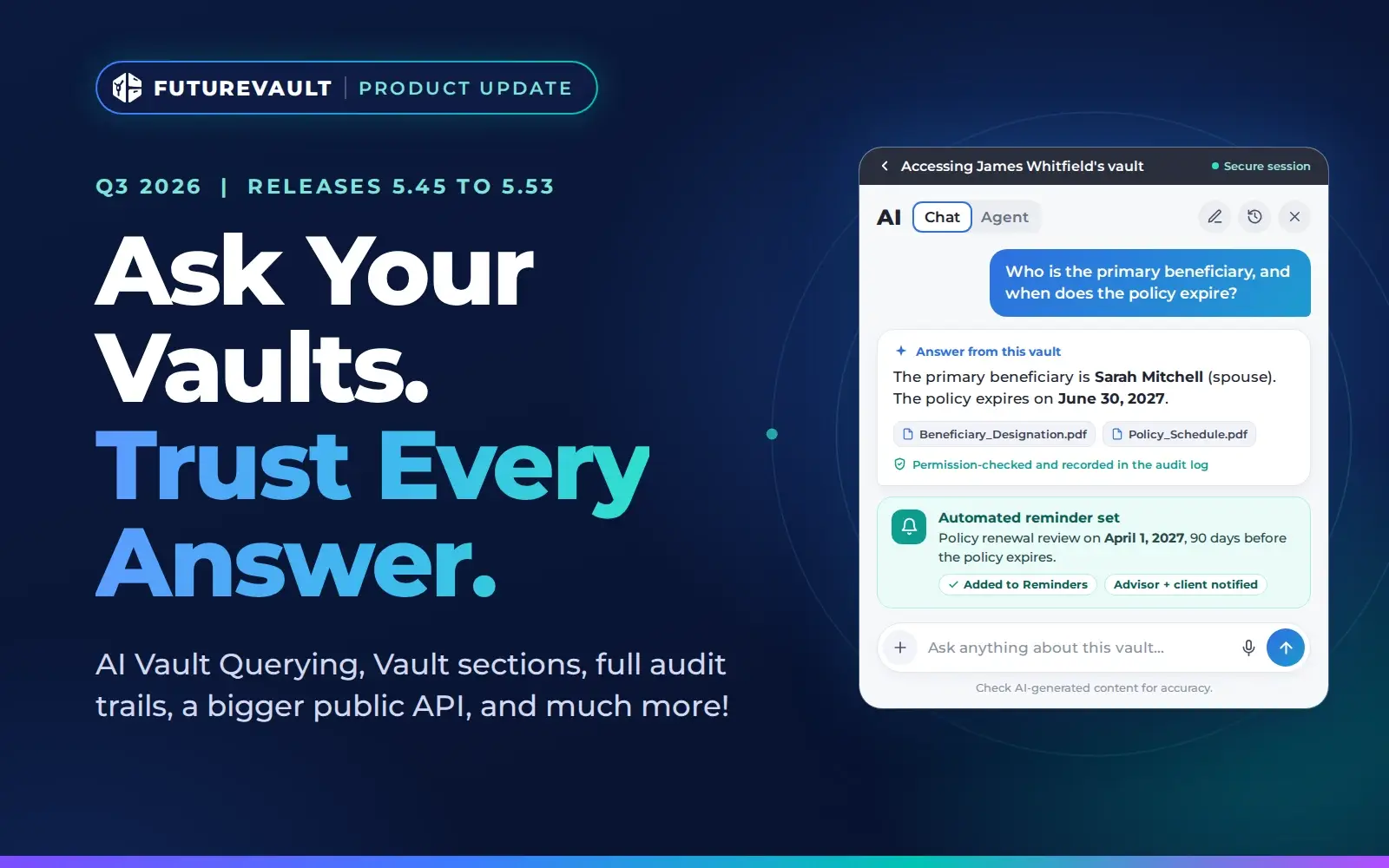
FutureVault’s Digital Vault platform supports features including structured document organization, document exchange, and easily manage user access permissions, document workflow automation, and audit trails.
This creates a practical information layer underneath an intergenerational continuity plan.
Instead of a family knowing that a will exists somewhere, the appropriate people can know:
- That the document exists
- Where it is located
- Who is responsible for it
- Who has permission to access it
- Which professionals may need to collaborate around it
This organization is particularly valuable when wealth transfers involve multiple members of the family and several professional advisors.
6. Coordinate Estate, Tax and Trusted Advisor Relationships
Intergenerational wealth transfer rarely sits entirely within the financial advisor’s remit.
It typically requires collaboration between several professionals, potentially including:
- Estate lawyers
- Accountants
- Tax professionals
- Insurance professionals
- Trustees
- Business advisors
- Financial planners
- Investment advisors
The financial advisor can play an important role in coordinating this network without attempting to replace the specialist advice each professional provides.
For high-net-worth (HNW) families in particular, tax, estate, business and investment decisions are often interconnected.
A change to one piece of the structure can affect several others.
Strong wealth-transfer planning therefore requires both professional collaboration and a reliable way to maintain the information supporting that collaboration.
Create a Trusted Advisor ecosystem
Advisors should know:
- Who the family's key external professionals are
- Which person is responsible for each part of the plan
- How those professionals communicate
- Where final documents are stored
- Which information can be shared between them
- Who has authority to grant access
- How updated documents are captured and retained
This is another area where secure permission-based document sharing can become materially more useful than exchanging sensitive documents over email.
The result is not simply better document management.
It is a more structured operating model around the family.
FutureVault’s Digital Vault technology allows access to be provisioned to specific Trusted Advisors and collaborators rather than requiring every party to have unrestricted access to the household’s information.
Important: Tax, legal and estate strategies should always be developed with suitably qualified professionals for the client’s circumstances and jurisdiction.
7. Use Digital Vault Technology to Operationalize Wealth Transfer at Scale
For an individual advisor managing several dozen households, it may be possible to coordinate wealth-transfer planning largely through manual processes.
For a wealth management firm supporting hundreds or thousands of households, that approach becomes much harder to scale.
The challenge is not merely storing files.
A firm needs to manage documents and information across:
- Head and back-office teams
- Advisors
- Individual clients
- Households
- Family members
- Trusted professionals
- Compliance personnel
- Multiple third-party systems
That is where the distinction between basic online storage and an enterprise Digital Vault becomes important.
What should wealth management firms look for in wealth transfer technology?
When assessing technology to support intergenerational wealth-transfer and continuity planning, consider whether it provides:
1. Structured household document management
The platform should make it easy to organise financial, legal, estate, insurance, tax and personal documentation around a client or household.
2. Granular access and permissions
Different family members and professionals should be able to access the information relevant to them without unnecessarily exposing everything else.
3. Secure document exchange
Advisors, clients and Trusted Advisors should have a secure mechanism to collect and exchange sensitive documents.
4. Multi-generational access
The technology should accommodate spouses, heirs and other family members as relationships expand beyond the original client.
5. Document automation
Firms managing large numbers of clients should be able to reduce manual document delivery, collection and administrative work.
6. Integrations
A wealth-transfer platform should work with the firm’s wider technology ecosystem rather than becoming another isolated repository.
7. Security, governance and auditability
Sensitive financial and personal information requires appropriate encryption, access controls, oversight and audit trails.
8. A client experience people will actually use
The value of a continuity platform disappears if clients and families cannot easily access the information they need.
FutureVault’s platform is purpose-built for financial services and wealth management and is designed to provide a secure document and information layer spanning back-office teams, advisors, clients and households. Current platform capabilities include secure document exchange, structured Digital Vaults, advanced permissions, document automation and integrations with other applications.
Digital Vault vs. a Traditional Client Portal for Wealth Transfer
A traditional client portal and a Digital Vault can overlap, but they are not necessarily the same thing.
A client portal is often primarily designed to give a client access to documents or information supplied by a financial institution.
A Digital Vault can act as a broader, persistent information environment for the household.
For wealth-transfer planning, that distinction matters.
| Capability | Traditional Client Portal | Advanced Digital Vault |
|---|---|---|
| Access financial documents | Typically | Yes |
| Secure document exchange | Varies | Yes |
| Organise broader household documents | Often limited | Yes |
| Granular family access | Varies | Yes |
| Trusted professional permissions | Varies | Yes |
| Support estate and continuity documentation | Not always a core use case | Yes |
| Document automation | Varies | Yes |
| Multi-tier firm/advisor/client structure | Varies | Yes |
| Audit trails and governance | Varies | Yes |
The objective is not to add another login to a client’s life.
It is to create a secure single source of truth for the important information and documents that support the client relationship and family continuity.
How to Choose a Wealth Transfer Platform
For wealth management firms evaluating technology for intergenerational planning, start with the operating problem rather than the feature list.
Ask:
Who needs access?
Will the platform support the firm, advisors, clients, spouses, heirs and external Trusted Advisors?
What information needs to be managed?
Consider financial statements, wills, trusts, insurance, tax records, legal documents, property information and other important household records.
How should information be structured?
A shared folder is very different from a repeatable household information model that can be deployed across thousands of clients.
How will documents enter the platform?
Evaluate integrations, APIs, automated document delivery and bulk processes rather than relying exclusively on manual uploads.
How are permissions governed?
Determine whether access can be controlled at an appropriate level for different family members and professionals.
What happens when circumstances change?
The platform should remain useful during succession, death, incapacity, business transfers and changes to the advisory relationship.
Can the firm operate it at scale?
The technology must work not only for an individual household but also for the teams responsible for administering and supervising thousands of client relationships.
For firms assessing a Digital Vault specifically for wealth-transfer and continuity use cases, these considerations can help distinguish an enterprise platform from basic document storage.
The Great Wealth Transfer Is a Relationship and Information Challenge
The largest wealth transfer in history represents an enormous opportunity for financial advisors and wealth management firms.
But the assets will not automatically remain where they are today.
Advisors need to earn the next generation’s trust.
That starts by developing relationships with spouses and heirs before a transfer takes place, building structured intergenerational plans, facilitating family conversations and coordinating the professionals surrounding the family.
The other half of the challenge is operational.
The documents, data and information required to execute a family’s plans must remain structured, secure and accessible to the right people.
This is where Digital Vault technology can become a powerful component of an intergenerational continuity strategy.
It gives firms an opportunity to move beyond simply managing the assets of one individual and create a secure information environment that supports the whole household, across generations.
The best time to begin that process is before the family needs it.
Frequently Asked Questions About Wealth Transfer Strategies
What is the Great Wealth Transfer?
The Great Wealth Transfer refers to the large-scale transfer of assets and wealth from older generations, particularly Baby Boomers, to spouses, children, grandchildren and other beneficiaries. Current estimates suggest approximately $124 trillion could transfer in the United States through 2048.
What are the best strategies for intergenerational wealth transfer?
Effective intergenerational wealth-transfer strategies typically combine early planning, involvement of spouses and heirs, family meetings, estate and tax planning, collaboration with Trusted Advisors, clear documentation and an organized system for maintaining the family’s critical financial information. The exact financial, legal and tax strategy will depend on the family’s circumstances.
How should financial advisors prepare for the Great Wealth Transfer?
Financial advisors should begin building relationships with spouses and next-generation heirs before wealth changes hands. Firms should also implement repeatable intergenerational planning processes, family engagement programmes, document-management systems and technology that can support multiple members of the household over time.
What technology can financial advisors use for wealth transfer planning?
Technology used in wealth-transfer planning can include financial-planning software, CRM systems, estate-planning tools, communication systems and Digital Vault platforms. Digital Vault technology can provide the secure document and information layer that connects clients, advisors, family members and other Trusted Advisors.
How does a Digital Vault help with intergenerational wealth transfer?
A Digital Vault centralizes important financial, legal, estate, tax, insurance and household documents in a secure digital environment. Advanced Digital Vault platforms can also provide different levels of access for family members and professional advisors, helping families keep critical information organized and accessible throughout a wealth transfer.
What should wealth management firms look for in a wealth transfer platform?
Wealth management firms should consider secure document exchange, household-level organisation, granular permissions, support for family members and Trusted Advisors, automation, integrations, security, auditability and the ability to deploy the technology consistently across a large number of households.
Why do financial advisors lose assets during intergenerational wealth transfers?
Lack of an existing relationship with heirs is a major risk. Recent Natixis research found that investors who planned to leave a benefactor’s advisor commonly cited already having their own advisor or having no personal connection to the incumbent advisor. Building relationships across the family before the transfer occurs can therefore materially improve an advisor’s position.