

You don’t have an AI problem; you have a document infrastructure problem. One of the single biggest barriers to effective AI in financial services isn’t AI itself—but the documents (and the infrastructure) that govern, power, and drive the business.
For many enterprises and firms, the conversation around AI has focused on models, copilots, tasks, and automation. Yet beneath the surface lies a more fundamental issue: the document layer.
Every FI and wealth management organization runs on documents—client onboarding forms, tax returns, statements, reports, estate plans, insurance policies, trust documents, investment policy statements, regulatory disclosures, and more. Documents that are far from peripheral to the business.
These documents are the lifeblood of every organization.
And yet, for most firms, the document layer remains fragmented, misunderstood, unmanaged, and invisible to the other critical technologies that support and drive the next wave of productivity and insight.
For firms expecting AI to deliver significant results, they must first address the infrastructure critical to everyday operations, compliance, and client servicing.
The Reality: Your Most Valuable Data Lives in Documents
Here’s the harsh reality: The majority of institutions and firms operate in a data-rich but information and insight-poor environment.
Industry estimates indicate that 80% to 90% of enterprise data is unstructured, much of which is contained in documents such as contracts, statements, emails, and reports.
Ultimately, this means information cannot be easily processed, queried, or analyzed by traditional systems.
And this is precisely what creates a massive disconnect and missed opportunities:
- Critical data and core insights about clients exist in documents
- Documents are scattered across siloed environments and systems
- AI and analytics tools cannot easily access them
The result is a vast reservoir of “dark data”—information that exists but cannot be leveraged efficiently or effectively.
According to multiple enterprise data studies, only a small fraction of unstructured data is actually analyzed, leaving massive amounts of value left behind on the table and trapped inside documents.
Within the day-to-day operations of wealth management and financial advisory firms, this problem snowballs.
Key client (and enterprise) intelligence often lives inside:
- PDFs
- scanned forms
- account statements
- trust agreements
- estate documents
- insurance policies
- tax filings
- handwritten notes
These are precisely the types of documents that most systems struggle to analyze.
The Hidden Operational Drag of Fragmented Documents
The cost of this fragmentation is rarely discussed—but it is significant.
When documents are spread across email, shared drives, CRMs, and legacy repositories, firms experience persistent operational friction:
- Teams spend hours searching for the right data and information
- Compliance teams struggle to gather evidence to become defensible
- Advisors and their support staff manually review documents before meetings
- Client intake, onboarding, and servicing slow down significantly
- Audit preparation and demonstrating compliance become painful
Across many industries, knowledge workers spend significant portions of their time simply searching for information across systems—a productivity drain that compounds at scale.
In financial services, where documentation is tied directly to regulatory obligations, the cost is even higher.
Firms frequently report operational inefficiencies that can create 20–30% productivity drag across document-heavy workflows—from onboarding to client servicing to compliance oversight.
During regulatory reviews, organizations often need to locate supporting documentation across multiple systems and repositories. Without centralized governance, structure, and indexing, this process turns into days or even weeks, rather than minutes.
This isn’t just inefficient.
It compounds operational and compliance risks.
Why AI Alone Cannot Solve This Problem
Many firms hope AI will magically fix these issues.
But AI has a prerequisite: structured, controlled, and governed access to documents and data.
Without this necessary foundation, AI tools operate in isolation.
Sure, they can summarize a single isolated document uploaded.
But they fail to contextualize, interpret, and understand the full client picture across hundreds or even thousands of documents, all of which often come from multiple different sources.
They cannot surface patterns across households.
They cannot detect risks across portfolios and holdings.
And they cannot deliver enterprise-grade insights to optimize client servicing and day-to-day operations.
As many enterprise data leaders now acknowledge, AI strategies fail not because of the model, but because of the document and data infrastructure beneath it.
In other words:
You don’t have an AI problem. You have a document (and document infrastructure) problem.
The Enterprise Document Layer: The Real Foundation for AI
To unlock the value trapped in documents, firms need something far more foundational than another AI tool.
They need a modern enterprise document layer built to support enterprise operations. An enterprise-grade Digital Vault.
This layer acts as the core infrastructure that governs, structures, and activates document intelligence across the organization.
A true enterprise document architecture provides:
1. A Single Source of Truth
Client, advisor, and enterprise documents are ingested, aggregated, and centralized within a secure single Digital Vault—from custodians, portfolio systems, tax platforms, CRMs, along with advisor, third party, and client uploads.
Moving away from siloed and fragmented document systems, enterprises can now leverage one centralized source of truth for documents.
2. Governance and Compliance by Design
When dealing with documents and their data, governance, control, and regulatory oversight is table stakes. Documents are governed through:
- role-based access and permissions
- audit trails and activity logging
- retention policies and monitoring
- secure access controls and provisioning of internal and external users
This governance layer ensures firms can leverage documents while maintaining data and information security and remaining compliant with regulatory frameworks.
3. Structured Metadata and Taxonomy
Documents should be no longer considered as static files required for compliance.
An enterprise-grade infrastructure (Digital Vault) moves documents from static files to structured data objects enriched with metadata, labels, classifications, and searchable attributes.
This structure enables automation, discoverability, and analysis.
4. AI-Ready Infrastructure
Once documents are structured and governed, they become the perfect input for:
- Intelligent Document Processing (IDP)
- machine learning
- Private LLMs
- Retrieval-augmented generation (RAG)
- Automated workflows with embedded client insights
This is when AI stops being a novelty and transitions to becoming a massive strategic advantage for advisors and for the enterprise.
From Document Vault to Intelligence Layer
This shift represents a fundamental evolution in how firms approach and think about documents as an overall operational and strategic growth lever.
Traditionally, documents have been viewed as static artifacts stored for compliance. Making them available for internal use for client servicing and externally for audits and regulators reviews.
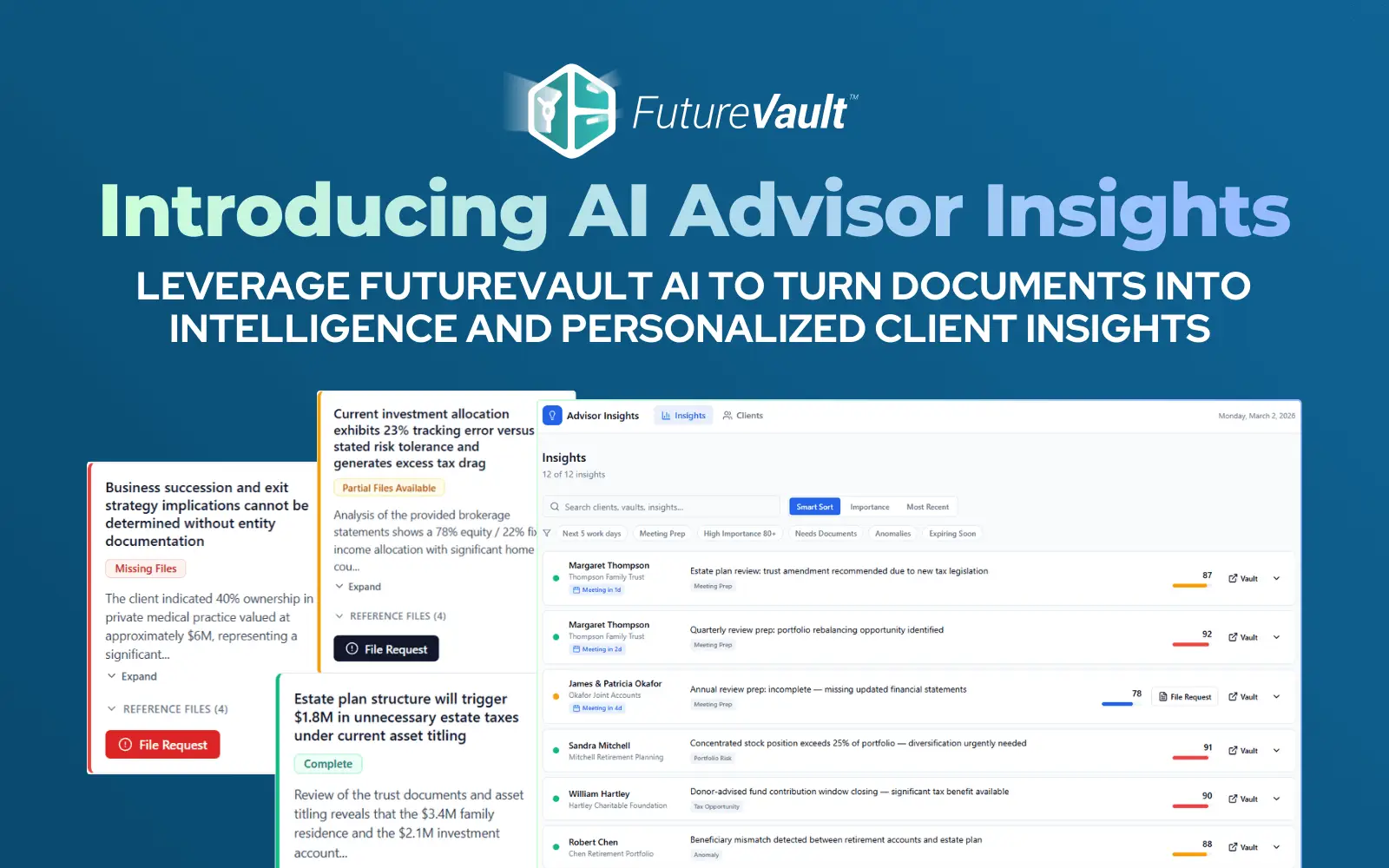
In today’s modern architecture, documents become the raw material for intelligence to drive enterprise, advisor, and client insights because of the context, accuracy, and richness of data they provide.
AI can now:
- Extract critical data points from documents
- Identify patterns across clients and households
- Surface compliance risks automatically
- Prepare advisors for client and prospect meetings
- Generate next-best actions and recommendations
- Identify opportunities for delivering better advice through planning or protection
What was once buried inside thousands of files becomes searchable, analyzable intelligence.
This is where business alpha emerges.
The Strategic Opportunity for Financial Institutions and Firms
The institutions and firms that recognize and invest in this shift will, without a doubt, gain a significant structural advantage.
Because while many organizations are experimenting with AI copilots and tools, relatively few are investing in the document infrastructure required to power them.
Yet this infrastructure sits at the center of nearly every core business function:
- Client onboarding
- Financial planning
- Portfolio management
- Compliance
- Audit readiness
- Client servicing
- intergenerational wealth planning
Documents power it all.
And when those documents become structured, governed, and AI-accessible, firms unlock an entirely new operating model.
One where insights are surfaced automatically. Workflows trigger themselves. And advisors (and their teams) spending less time hunting for information—and more time delivering value to clients.
Why the Document Layer Must Come First
Many advisory firms have modernized their CRM systems.
They have upgraded client portals.
They have implemented digital onboarding.
But beneath all of that modernization lies a stubborn bottleneck:
Documents and the infrastructure to scale their document operations.
The industry still relies heavily on:
- Shared drives
- Email attachments
- Manual uploads
- Disconnected repositories creating enterprise siloes
This fragmentation slows growth, increases compliance risk, and prevents AI from working at scale.
Fixing the document layer solves all three.
The Future: Document Intelligence as Competitive Advantage
The next phase of financial services innovation will come from AI applied to the most valuable source of data across the enterprise—documents.
When firms build the right infrastructure, documents inevitably become a living intelligence layer driving client and advisor insights at scale.
At FutureVault, this is precisely the foundation we’ve built.
A secure, enterprise-grade digital vault architecture designed to:
- Centralize documents
- Enforce governance
- Structure data
- Activate embedded AI
So firms can turn documents—and the data inside them—into insights, intelligence, and action.
The Bottom Line…
Every enterprise, FI, and wealth management firm is in the midst of deploying AI.
But very few have taken the right steps to deploy AI effectively, with the right underlying foundation and architecture.
In financial services, the most accurate and richest source of data lives in documents.
The firms that recognize this reality will invest where it matters most—
not just in peripheral AI tools, but in the document infrastructure that enables AI as a massive business alpha.
Frequently Asked Questions (FAQ)
Why are documents so important in financial services?
Documents are the foundation of nearly every core workflow in financial services. Client onboarding, financial planning, compliance oversight, regulatory reporting, estate planning, insurance analysis, and audits all depend on document-based information such as statements, tax filings, legal agreements, and disclosures.
Because so much client intelligence resides inside documents, they effectively serve as the operational backbone of financial institutions. When documents are fragmented across systems or poorly structured, firms experience slower processes, higher compliance risk, and limited ability to extract insights.
What percentage of financial services data is unstructured?
Most industry estimates indicate that 80–90% of enterprise data is unstructured, meaning it exists in formats such as PDFs, emails, scanned documents, and contracts rather than structured databases.
Within financial services, much of this unstructured data resides in:
- Client statements
- Investment reports
- Legal agreements
- Tax documents
- Insurance policies
- Onboarding forms
This is one of the primary reasons firms struggle to extract insights from their information without specialized document intelligence technologies.
Why is unstructured data a challenge for AI?
AI systems require structured, accessible data to produce reliable results. When critical information is buried inside documents—especially PDFs or scanned files—traditional systems cannot easily query or analyze it.
Without proper document infrastructure, AI models cannot:
- Access relevant information and data
- Contextualize and understand client relationships across documents
- identify patterns, opportunities, or risks
- Generate reliable insights and next-best-actions
This is why many enterprise AI initiatives stall: the data exists, but it is locked inside documents.
What is an enterprise document layer?
An enterprise document layer is a centralized infrastructure that manages, governs, and structures documents across an organization.
It typically includes:
- Centralized document storage
- Structured metadata and taxonomy
- Role-based access controls
- Compliance retention policies
- Audit trails and logging
- Integrations with enterprise systems
This architecture transforms documents from static files into searchable, governed data assets that can power automation and AI.
What is Intelligent Document Processing (IDP)?
Intelligent Document Processing (IDP) is a technology that uses AI, machine learning, and natural language processing to extract and structure information from documents.
IDP can automatically identify and extract data such as:
- Names and addresses
- financial values
- Beneficiary information
- Account numbers
- Policy details
- Key contractual terms
- Expiration and renewal dates
Once extracted, this information can be routed into downstream systems such as CRMs, compliance tools, or analytics platforms.
What are the benefits of a centralized Digital Vault for financial firms?
A centralized digital vault provides several operational and strategic advantages:
- Single source of truth for client documentation
- Faster onboarding and servicing workflows
- Improved data security and regulatory compliance
- Simplified audit preparation
- Better collaboration with clients and advisors
- AI-ready infrastructure for document intelligence
By consolidating document management into one governed platform, firms reduce operational friction and unlock new opportunities for automation and analytics.
What role will document intelligence play in the future of wealth management?
Document intelligence is expected to become a critical capability for financial institutions.
As AI systems mature, firms will increasingly use document data to:
- Surface client insights automatically
- Detect operational and compliance risks
- Prepare advisors for meetings
- Identify advice and planning opportunities
- Automate operational workflows
In this future model, documents evolve from static records into an intelligence layer that powers decision-making across the enterprise.