

The ever growing number of documents flowing through your organization such as loan applications, KYC packets, client on-boarding forms, tax filings, compliance reports, contracts are not merely administrative overhead. They are the operational heartbeat of any organization operating within the financial industry. And for decades, processing them has been a fundamentally human driven, slow, and error-prone endeavor.
That is changing. Rapidly.
Intelligent Document Processing (IDP) — the convergence of AI, machine learning, natural language processing, and large language models (LLMs) into a single document automation layer is moving from pilot project to operational imperative across banking, insurance, wealth management, and investment management. According to Precendence Research, the global IDP market valued at approximately USD $3.22 billion in 2025 is projected to reach up to USD $13.75 billion by 2030 reflecting a compound annual growth rate of 33.68% (Source: Intelligent Document Processing (IDP) Market Size, Share and Trends 2025 to 2034). Financial services is the single largest vertical driving that growth, accounting for 25–35% of all IDP deployments globally.
For C-suite leaders in finance, the question is no longer whether to adopt IDP. It is how quickly you can scale it and how much competitive ground you can afford to cede while you wait.
What Is Intelligent Document Processing and Why Now?
IDP is not a single technology. It is an AI-powered pipeline that reads, classifies, extracts, validates, and routes document data at scale helping replace manual data entry across every document-intensive workflow in your organization.
The technology stack underpinning modern IDP includes six converging capabilities: advanced optical character recognition (OCR), natural language processing (NLP), machine learning for classification and extraction, computer vision for layout analysis, robotic process automation for downstream routing, and heavy lifting by large language models (LLMs) such as GPT-4, Claude, and Gemini.
It is the LLM layer that marks the true inflection point. Traditional IDP required weeks of custom template configuration for each new document type and hundreds of labeled training examples. Modern LLM-enhanced IDP enables zero-shot extraction — processing document types the system has never encountered before, with minimal or no custom training. New document type on-boarding has dropped from weeks to hours. Setup costs that previously blocked adoption have collapsed.
“The biggest near-term opportunity for AI in financial services is not in exotic trading algorithms — it is in the mundane but massive task of processing the billions of documents that flow through the system every year” — McKinsey & Company
Gartner has predicted that by 2027, 50% of Intelligent Document Processing solutions will incorporate generative AI capabilities, up from less than 10% in 2023 and that GenAI will reduce the need for custom-trained document models by 70% by 2026.
PwC’s 28th Global CEO Survey found that 47% CEOs surveyed say that their biggest priorities over the next three years are integrating AI (including generative AI (GenAI)) into technology platforms as well as business processes and workflows.
Forrester expects GenAI-enhanced IDP to become the default approach for new enterprise deployments by 2026. The shift is not incremental — it is architectural.
IDP Adoption Across Financial Services: Where the Industry Stands
Adoption is accelerating across every financial services subsector, though maturity levels vary considerably. Accounts payable and corporate finance functions lead adoption with invoice processing serving as the classic gateway use case. Retail banking sector adoption has been increasing driven by KYC/AML obligations and loan origination volumes. Wealth management trails the pack but represents one of the highest-value opportunities precisely because of that gap.
| Subsector | Piloting | Enterprise-Wide | Primary Use Cases |
|---|---|---|---|
| Accounts Payable / Finance | 55–70% | 25–35% | Most mature; invoice processing is the gateway use case |
| Retail Banking | 50–65% | 20–30% | KYC/AML, loan origination, account opening |
| Insurance | 45–60% | 15–25% | Claims intake, underwriting, policy administration |
| Wealth Management | 30–45% | 10–20% | Client on-boarding, ACAT transfers, regulatory forms |
| Investment Management | 25–40% | 10–15% | Trade confirmations, prospectuses, SEC filings |
Deloitte’s 2020 Global Intelligent Automation Survey found that 74% of financial services organizations were using or piloting intelligent automation. With document processing cited among the top three use cases by more than 70% of respondents. Gartner reports that 59% of financial services firms will have adopted AI-augmented document processing as of late 2025, up from 37% in 2023. Everest Group documented 35–40% year-over-year IDP market growth in 2023 lead by financial services as the fastest-growing vertical.
The gap between adopters and laggards is widening. Organizations processing documents 5–10x faster are on-boarding clients sooner, closing deals faster, and responding to market changes with structural agility that manual operations cannot match. Forrester indicates automation leaders achieve 2.5x revenue growth compared to laggards.
High-Impact Use Cases: Where IDP Transforms Financial Services
KYC and AML Document Processing
Anti-money laundering and know-your-customer compliance represent one of the most significant document burdens in financial services. Large banks spend $500 million to $2 billion annually on KYC compliance alone. Manual KYC processing takes 30–60 minutes per customer; IDP-assisted processing takes 5–10 minutes driving a 70–80% reduction. Error rates drop from 15–20% (manual) to 2–5% (IDP-assisted). With global AML fines exceeding USD $6 billion in 2025, the compliance imperative is not abstract.
Loan and Mortgage Origination
The average mortgage involves 500–1,500 pages of documentation. Document-related delays account for approximately 30% of total mortgage cycle time. IDP compresses the average close cycle from 45–60 days to 15–30 days with per-loan document processing savings of $500–$1,500. For high-volume originators processing thousands of loans monthly, this is transformational — both for unit economics and for borrower experience.
Client Onboarding in Wealth Management
Traditional wealth management on-boarding involves 50–100+ pages per client, 10–20 forms, and 1–3 weeks of elapsed time. This full process comprise 65–70% of an advisor’s time spent on paperwork rather than client relationships. IDP plus workflow automation reduces on-boarding to 1–3 days. Signicat’s 2022 research found that 68% of consumers have abandoned a financial services on-boarding process due to friction. Every day reduced from on-boarding is revenue accelerated and attrition prevented.
Tax Document Processing and Estate Planning
For wealth management firms, tax season is a document processing surge with high-net-worth clients generating 50–200+ tax documents annually. Manual K-1 processing takes 15–30 minutes per document; IDP reduces this to 1–3 minutes with 95–99% extraction accuracy on structured forms.
Estate planning presents a similar opportunity. Advisors currently spend an estimated 20–40% of their time on document-related administrative tasks. Kitces Research found that advisors spend approximately 50% of total working hours on activities other than direct client interaction — a productivity drain that IDP directly addresses.
Compliance and Regulatory Filings
Financial institutions track an average of 250 regulatory alerts per day globally. According to a 2021 study sponsored by the Federal Reserve and the Federal Deposit Insurance Corporation (FDIC), compliance takes up around 10% of a financial institution’s personnel expenses including salary and benefits.
IDP automates 40–60% of the data extraction required for regulatory reporting, reduces filing error rates from 5–10% (manual) to under 1%, and accelerates Suspicious Activity Report filings by 40–60%. As regulatory complexity continues to expand, the scalability of automated document processing becomes a structural competitive advantage.
The Generative AI Inflection Point
The integration of large language models into IDP pipelines is not an incremental improvement — it is a category shift. Traditional IDP excelled at structured documents with predictable layouts. LLM-enhanced IDP performs across the full spectrum: structured, semi-structured, and unstructured documents alike.
The accuracy improvement is material. On semi-structured documents, LLM-enhanced IDP achieves 90–97% accuracy versus 75–85% for traditional approaches showing a 12–15 percentage point improvement. On unstructured documents, the gap widens to 20–30 percentage points. Straight-through processing rates (the percentage of documents handled with zero human intervention) rise from 50–70% (traditional IDP) to 70–90% (LLM-enhanced).
New capabilities emerge entirely: contextual reasoning across multi-page documents, cross-document analysis, natural language querying of document contents, anomaly and fraud detection, and multilingual processing across 50+ languages. The addressable scope of IDP expands by an estimated 40–60% when LLMs enter the stack.
“By 2026, 30% of enterprises will have automated more than half of their document processing activities — up from less than 10% in 2023.” — Gartner
The Intelligent Document Lifecycle: IDP and the Digital Vault
Processing documents intelligently solves only half the problem. The other half is what happens to those documents and the data they contain after they are processed. This is where the integration of IDP with a secure digital document vault creates compounding value.
The data extracted from documents does not disappear into a filing cabinet. It becomes searchable, queryable intelligence. For example. advisors surface expiring insurance policies, estate document gaps, beneficiary inconsistencies, and tax planning opportunities can proactively from stored data in the digital vaults. Everest Group has noted that financial services firms are increasingly seeking end-to-end document lifecycle solutions: not just extraction, but classification, validation, storage, and retrieval. This convergence of IDP and secure document infrastructure is where the next wave of advisor productivity gains will be realized.
How Can FutureVault Create Value For Your Organization
At FutureVault, we have built our platform around the insight that financial firms need more than storage. They need an intelligent document life cycle: ingestion, classification, extraction, validation, secure storage, organized retrieval, and proactive intelligence contained in a single, compliance-ready workflow.
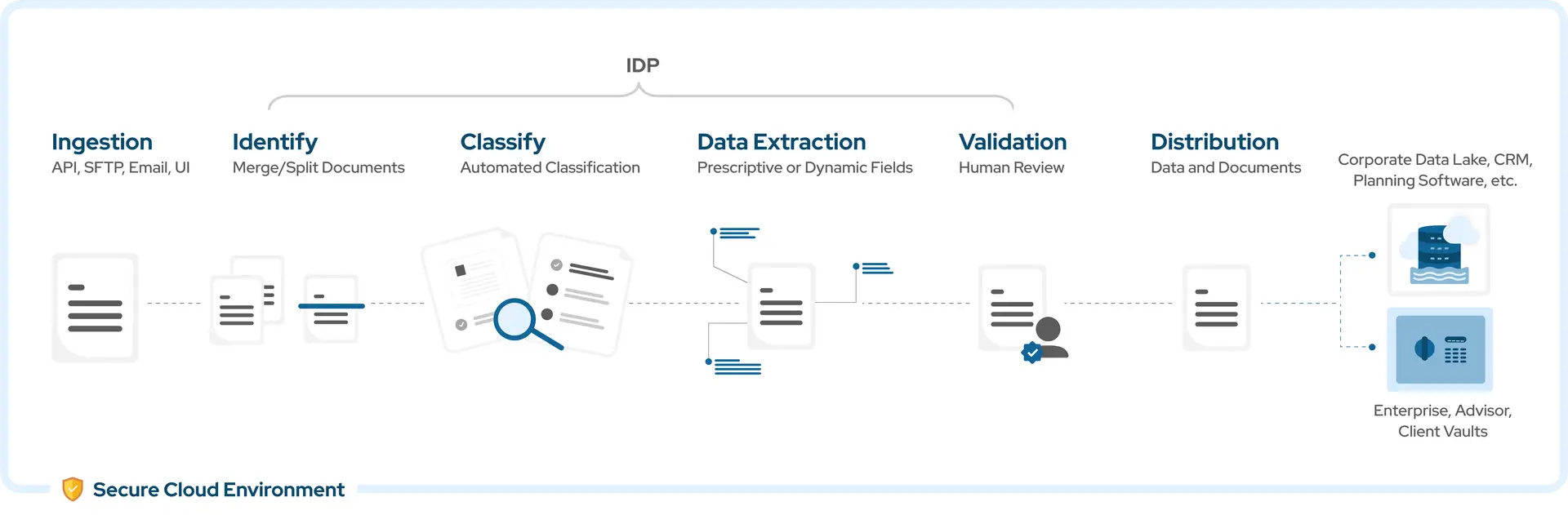
For example – a client uploads a tax document to their FutureVault digital vault. IDP immediately identifies it as a 1099-DIV, extracts dividend income, account number, and tax year, automatically populates structured fields accessible to the advisor, and routes the document to the correct folder with appropriate retention policies applied in seconds without having an advisor intervene.
Another example – client on-boarding documents arrive from multiple channels: the client portal, email, custodian feeds. IDP helps classify each document, extracts key data, populates on-boarding forms, flags discrepancies, and stores everything in the advisor’s and clients’ synchronized vaults reducing what was a 3-week manual process to a single business day.
The Strategic Case: Why IDP Is Now a C-Suite Imperative
The business case for IDP investment for the financial industry rests on five converging imperatives:
- Cost reduction at scale: Manual document processing costs $6–$25 per document; IDP reduces this to $0.50–$2.00 — a 70–90% reduction. For organizations processing millions of documents annually, this compounds into hundreds of millions in operational savings.
- Regulatory compliance and risk reduction: IDP creates defensible, auditable document trails with every extraction logged making every decision traceable. As regulatory fines escalate (cumulative GDPR fines exceeded €4.5 billion by 2024), the risk mitigation value is quantifiable.
- Scalability without proportional headcount: Traditional document processing scales linearly. IDP breaks this constraint. Cloud-based IDP scales elastically handling quarter-end surges, M&A integration volumes, and regulatory filing deadlines without proportional staffing increases.
- Talent reallocation and retention: Knowledge workers spend 15–25% of their time searching for and processing documents (IDC). IDP eliminates this low-value work, freeing advisors, analysts, and specialists for client relationships and strategic decisions improving retention in a tight labor market.
- Client experience differentiation: Next-generation clients expect digital document experiences. Firms delivering instant on-boarding, same-day document processing, and proactive document intelligence will define the new standard. Those that do not will find themselves defending client attrition rather than driving new client acquisition.
“Intelligent automation in financial services will be document-first, because documents are the lifeblood of financial transactions.” — Craig Le Clair, VP/Principal Analyst, Forrester
McKinsey estimates generative AI could deliver $200–$340 billion in annual value to the banking sector.
Accenture projects that intelligent automation could save the banking industry $70 billion by 2025.
Deloitte found that IDP achieves 60–80% processing time reduction and 50–70% cost reduction in financial services deployments.
The ROI data is clear: financial services IDP deployments consistently generate 300–400% returns within 18–24 months. The question for financial services leadership is not whether the economics work. It is who captures the advantage.
Where IDP Is Heading For Finance
Intelligent document processing is not a technology on the horizon. It is a technology in deployment at JPMorgan, Morgan Stanley, HSBC, Deutsche Bank, Goldman Sachs, and hundreds of regional banks, insurers, and wealth management firms building competitive advantages today.
The BFSI sector accounts for the largest share of IDP adoption globally, and for good reason: no industry is more document-intensive, more compliance-burdened, or more directly rewarded for processing speed and accuracy. The firms investing now are not just reducing costs but they also actively building operational infrastructure that will be increasingly difficult for laggards to replicate.
The generative AI inflection point has eliminated the primary friction that stalled earlier generations of document automation: setup complexity, template brittleness, and the need for extensive labelled training data. The barriers are lower than they have ever been. The ROI is proven. The competitive stakes are rising.
At FutureVault, we believe the future of financial services belongs to firms that treat their documents not as administrative burden, but as strategic assets helping intelligently process, securely store, and continuously surfacing value when needed. The technology to get there exists today.