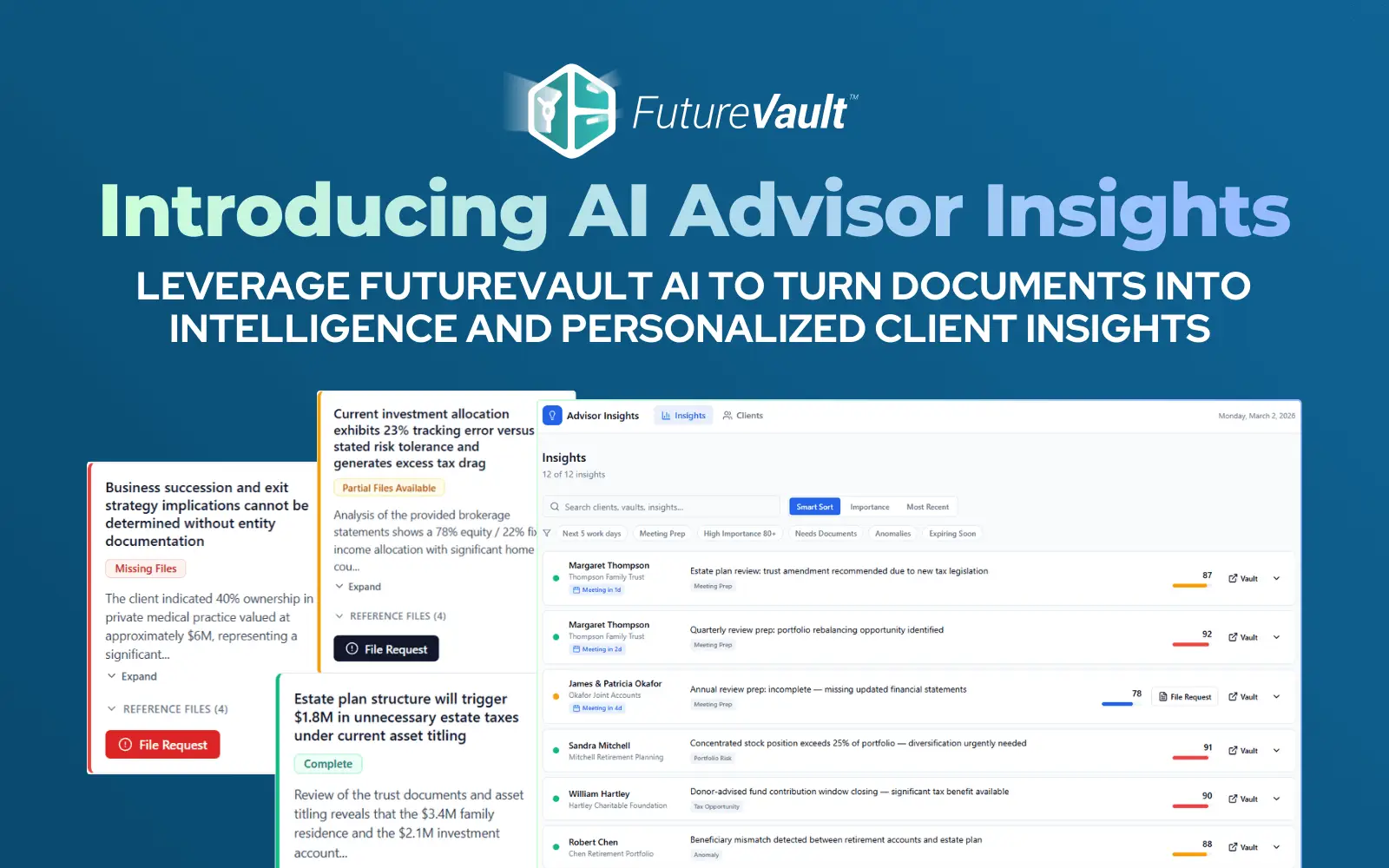


Digital Vaults combined with AI and private Large Language Models (LLMs) create an increasingly important category of data management — Intelligent Document Processing (IDP) — where static documents are transformed into dynamic enterprise assets. Firms can now extract, structure, and contextualize critical (and captive) data from documents, at scale and automatically, into an intelligent system that delivers real-time insights, automated workflows, and compliance-ready outputs.
This technology category has been growing at a CAGR of 37% because it provides financial organizations with significant value compared to standalone data. The technology can be used to summarize documents, extract key data points, and query across multiple documents or an entire document vault. Integrating IDP capabilities with a digital vault platform provides a powerful solution for managing and deriving insights from an organization’s massive amount of document-driven data.
In an exclusive interview, William Hortz (Founder and Dean of IID) reached out to FutureVault’s Daniel Kenny, Chief Executive Officer, and Kristian Borghesan, Chief Marketing Officer, to learn more about our award-winning white-label, AI-powered digital vault platform for financial institutions.
Hortz: Can you explain what Intelligent Document Processing is and why it has emerged as an important technology advancement for financial firms?
Kenny: Intelligent Document Processing (IDP for short) refers to the use of AI, machine learning, and language models to automatically classify documents, extract relevant data, and understand context across unstructured content such as PDFs, scanned images, emails, documents, and forms. Unlike traditional Optical Character Recognition (OCR), which simply converts text from an image into characters, IDP now understands what a document is, what information matters, and how that information should be used downstream. In financial services where documents are foundational to many critical client interactions, operational processes, and regulatory requirements, this distinction is critical.
IDP has emerged as an essential capability because the industry has reached the limits of manual and semi-automated document handling that is required to not only scale but even to simply manage the status quo.
Borghesan: Institutions and firms are managing growing volumes of documents while facing tighter regulatory scrutiny, higher client expectations, and pressure to operate more efficiently. Traditional processing methods introduce risk through inconsistency, incompleteness, and human error, and they scale linearly with headcount.
It is essential to acknowledge that data embedded in documentation is worth materially more than raw data due to the context it holds and represents, as well as its inherent richness. In the context of applications, loans, and especially legal matters, disputes, and litigation, the document is almost always the golden source of truth.
IDP addresses this by turning documents (where data is captive) into structured, reliable data that can be governed, audited, and integrated into enterprise systems. Something financial institutions have needed for a long time but have not had the tools to do this effectively and at scale until now.
Hortz: Can you expand on the benefits and use cases of Intelligent Document Processing for financial services?
Borghesan: The benefits of IDP extend well beyond efficiency, although that is often where firms see impact first. By automating document classification, validation, and data extraction, IDP materially accelerates processing times across onboarding, compliance, account servicing, audits, reporting, and so on. Tasks, over the course of a year, that once required manual review of thousands, better yet, millions of pages can be completed in hours or days with far greater consistency and traceability.
Just to give you one real-world example, we recently partnered with a large insurance conglomerate on a document processing initiative involving approximately twenty million pages of scanned historical documents. Using IDP, we classified and identified document types, extracted specific data fields from each, and delivered the output in a structured format ready for ingestion into their internal systems. The project was completed in roughly five weeks.
Kenny: On the flip side, using traditional, manual document review, this effort would have required dozens of resources and taken years to complete. In reality, it would likely never have been completed at all. That gap between what is theoretically possible and what is practically achievable is where IDP delivers its greatest value.
Hortz: How do AI and LLM systems unlock the value of data contained within documents, and how do they determine what information to extract?
Kenny: AI and private large language models (LLMs) unlock document value by interpreting context, structure, and meaning rather than relying on rigid templates or fixed rules. Financial documents vary widely in format, language, and quality – particularly when dealing with scanned or legacy content. LLMs are able to understand these variations and identify relevant information even when documents are incomplete, inconsistent, or poorly structured, which is where traditional automation almost always fails and leads to operational leaks.
Borghesan: The information extracted from documents is usually driven by the business rules and requirements of the enterprise. Different functions care about different data and different firms might be required to evidence differing information and data. Compliance teams may focus on completeness, signatures, and disclosures. Advisors may need beneficiary details, asset values, or restrictions. Operations teams may prioritize identifiers and system-ready fields. Effective IDP systems are designed to align extraction logic with specific use cases, ensuring that the output is accurate, relevant, and usable—not just technically extracted, but operationally meaningful.
Hortz: What specific capabilities are you designing for advisors and clients by integrating AI and LLMs with digital vault technology?
Borghesan: For advisors and clients, the integration of AI and private LLMs contained within a secure digital vault provides a “single source of truth” where all documents across the relationship reside, reducing friction and increasing clarity.
Today, it is more than common for critical client information to be spread across dozens of documents across multiple systems, making it time-consuming and costly to assemble a complete picture; not to mention this results in a poor experience on both sides. By applying an intelligence layer on top of a digital vault, advisors can surface timely and relevant information and insights across documents without manually searching or combing through files one by one.
Kenny: This foundation enables higher-value capabilities such as rolled-up document summaries and Next Best Actions for advisory teams. Advisors can quickly understand what has changed, what is missing, or what requires attention – whether that is expiring documents, incomplete records, or opportunities to deliver better advice all around.
The goal is not necessarily automation for the sake of automation, but to remove administrative burden and reduce the risk of oversight, allowing advisors to focus on informed decision-making and higher-quality client engagement.
Hortz: What other advancements or applications do you see emerging with Intelligent Document Processing?
Kenny: The next major advancement in IDP that we see is the shift from reactive processing to proactive, autonomous, end-to-end workflows. Rather than documents being reviewed after the fact, intelligence can be applied as documents enter the system from any source (client, third-party systems, advisor uploads, etc.), triggering actions such as routing tasks, updating records, flagging exceptions, or initiating follow-ups automatically. This reduces delays, eliminates manual handoffs, and improves overall governance.
Borghesan: Over time, this leads to autonomous processing loops where document data continuously improves enterprise operations. Incomplete or inconsistent information is identified immediately, risks are surfaced earlier, and downstream systems stay aligned without manual intervention.
For institutions, lines of business, and advisory teams this means stronger controls, cleaner data, and better client experiences and personalized advice delivered at scale.
FutureVault is an award-winning AI-Powered Digital Vault platform for FIs, enterprise wealth management firms, lines of business, and wealth advisory operations.
FutureVault’s white-labelled platform automates, aggregates, and centralizes critical client, advisor, and enterprise documentation. Powered by AI in combination with intelligent OCR, FutureVault’s Intelligent Document Processing engine extracts critical data from documents, driving straight-through processing for back, middle, and front office functions, while delivering intelligence and insights for advisors and their clients.
FutureVault’s multi-level architecture supports and syncs with enterprise-level roles and permission structures, providing a data governance layer across lines of business and client-facing teams. FutureVault is built on modern APIs and is SOC 2 Type II and PCI DSS compliant.
Learn more about FutureVault at www.futurevault.com
The Institute for Innovation Development is an educational and business development catalyst for growth-oriented financial advisors and financial services firms determined to lead their businesses in an operating environment of accelerating business and cultural change. We operate as a business innovation platform and educational resource with FinTech and Financial Services firm members to openly share their unique perspectives and activities. This interview is for informational purposes only. The goal is to build awareness and stimulate open thought leadership discussions on new or evolving industry approaches and thinking to facilitate next-generation growth, differentiation, and unique client/community engagement strategies. The Institute was launched with the support and foresight of our founding sponsors — Ultimus Fund Solutions, FLX Networks, TIFIN, Advisorpedia, Pershing, Fidelity, Voya Financial, and Charter Financial Publishing (publisher of Financial Advisor and Private Wealth magazines).