

When Craig Iskowitz of the WealthTech Today podcast sat down with FutureVault CEO Daniel Kenny for Episode 348 of the WealthTech Today Podcast, the conversation went somewhere most vendor interviews don’t: it went deep into the infrastructure question that every wealth management firm is quietly wrestling with right now. Not which AI tool to buy — but whether their document foundation is actually ready for AI at all.
The answer, for most firms, is no. And that gap is exactly where FutureVault has spent the better part of a decade building.
Craig Iskowitz, whose firm Ezra Group runs AI governance audits across the wealth management industry, opened the episode with a note that cuts to the heart of the matter: firms are increasingly coming to him not to select AI tools, but to figure out how to build governance around AI they’ve already bought. How do you verify that vendors are handling sensitive client data carefully? How do you prevent that data from leaking into public models? How do you trace an AI-generated recommendation back to its source?
These aren’t abstract compliance questions. They’re the foundational requirements for responsible AI deployment in a regulated industry. And they’re questions that FutureVault’s architecture was, somewhat remarkably, already designed to answer — before AI agents became a boardroom priority.
The Category Creator That Had to Wait for the Market
FutureVault didn’t join the digital vault space. It created it. And as Kenny described to Iskowitz, that pioneer position came with a familiar challenge for category-defining companies: explaining the product and educating the market before the market was familiar with the vocabulary and ready to embrace it.
Two to four years ago, the typical response from prospects was some version of “very interesting, not right now.” Other priorities. Tighter budgets. The concept made sense in theory, but it didn’t feel urgent.
That has changed. Those same prospects are now circling back. The same firms that passed in 2021 and 2022 are reaching out now, asking to re-engage with the digital vault conversation they left on the table. Information security, data privacy, and the explosive adoption of AI have collectively raised the stakes around document governance to a level that firms can no longer defer.
“We were ahead of our time,” Kenny told Iskowitz. “We’ve been able to hang on until the market caught up.”
The growth story Daniel sketched is one with a genuine hockey-stick shape now forming, not just in revenue conversations, but in the sheer volume of end-client digital vaults deployed and documents under management. The blade of the curve, as Kenny put it, is finally showing.
The Vault Is Not the Portal… A Distinction That Matters
One of the cleaner conceptual clarifications in the episode comes when Iskowitz raises the overlap between digital vaults and client portals. Most portals include a documents section. So why isn’t that enough?
Kenny’s answer reflects FutureVault’s core go-to-market thesis: the documents section of a portal is almost never the core expertise of the portal provider. Portfolio management, asset review, and client performance reporting are among the primary capabilities a portal is optimized for. Documents are an afterthought. A folder hierarchy with a few upload functions, basic access controls, little to no search functionality, and limited upload and sharing capabilities.
FutureVault’s position to its integration partners is straightforward: don’t compete in your weakest area. Stick to your swim lane. FutureVault handles the vault through single sign-on, deep API connectivity, and purpose-built document intelligence. The result is a client experience that neither party could deliver alone.
This best-of-breed philosophy is backed by substance. FutureVault earned a WealthTech Integration Score of 8.4 from Ezra Group, placing it in the superior category and within the top 8–9% of all vendors evaluated across the wealth management technology landscape. Iskowitz, who runs that scoring program, offered the congratulations unprompted. The score reflects depth across CRM integrations, portfolio management systems, custodians, and client portals. You can explore the full FutureVault integration ecosystem to see the breadth of connections across the platform.
Three Layers, One Architecture: Documents, Governance, and Intelligence
The most technically substantive portion of the conversation centers on FutureVault’s three-layer platform architecture — and it’s worth unpacking clearly, because this is where FutureVault’s differentiation becomes most concrete.
Layer 1: Documents. Everything starts with the document layer — the ingestion, storage, and organization of documents across client, advisor, and enterprise vaults. This is where raw content enters the platform. What FutureVault’s Intelligent Document Processing (IDP) engine does at this stage already separates it from general-purpose tools: it classifies documents on input, determines their type, and routes them appropriately. The system handles structured and unstructured content alike — tax forms, handwritten notes, scanned PDFs, legacy brokerage statements — with extraction accuracy Kenny cited at 99%, routed across multiple OCR engines based on document type and confidence thresholds. Documents that fall below a confidence interval go into an exception review queue for human verification rather than passing through with degraded data quality.
Layer 2: Governance. As documents enter the platform, the governance layer activates. This is FutureVault’s most foundational — and most differentiated — capability. Every document is tagged and associated with household members, financial accounts, and client IDs. A rich metadata layer then drives a permissioning matrix that determines who can access which documents, at what level of specificity. Access can be scoped to a particular client, a specific account, an individual household member, or a defined document type. A complete audit trail runs across all of it.
This governance architecture wasn’t built for AI. It was built because FutureVault is a platform for regulated entities — wealth managers, RIAs, broker-dealers, family offices — where access control is a compliance requirement, not a nice-to-have. But as Kenny noted, this means the guardrails for agentic AI deployment were already in place before AI agents became a topic. The platform didn’t need to retrofit governance onto an AI layer. The AI layer gets extended by a governance foundation that already existed. Learn more about FutureVault’s security and compliance infrastructure.
Layer 3: Intelligence. The intelligence layer sits above governance and operates on the structured, permissioned data the lower layers produce. This is where FutureVault’s AI capabilities live — including document summarization, data extraction, next-best-action signals, and insights routed to CRMs and financial planning tools. When a 1099 lands in the vault, governance determines who can see it; the intelligence layer can then identify a tax planning opportunity and fire that signal to the advisor’s CRM without any manual intervention.
Alpha Content: The Competitive Moat Most Firms Are Missing
Iskowitz pressed on a pointed question: with every vendor claiming AI-powered capabilities, what does FutureVault’s intelligence layer surface that a standard compliance rules engine isn’t already catching?
Kenny’s answer centers on a concept FutureVault calls Alpha Content — documents that enter the vault from clients themselves, outside of what the wealth manager directly provides. Life insurance policies, trust documents, and external account statements. Content that the advisor would not otherwise have visibility into.
Traditional compliance rules engines are rule-based by definition: if this condition is met, execute that response. The rules operate on the data the system already has. FutureVault’s model is different because it becomes the aggregator. It ingests data and documents from CRMs, portfolio management tools, financial planning systems, and client-uploaded content — building what Kenny described as a 360-degree view of the client that includes information that has never previously been surfaced to the advisor.
Alpha content, applied to large language models alongside firm-generated data, produces more accurate, more contextual insights and meaningfully reduces hallucination risk. The model is operating on richer source material, not inferring from gaps.
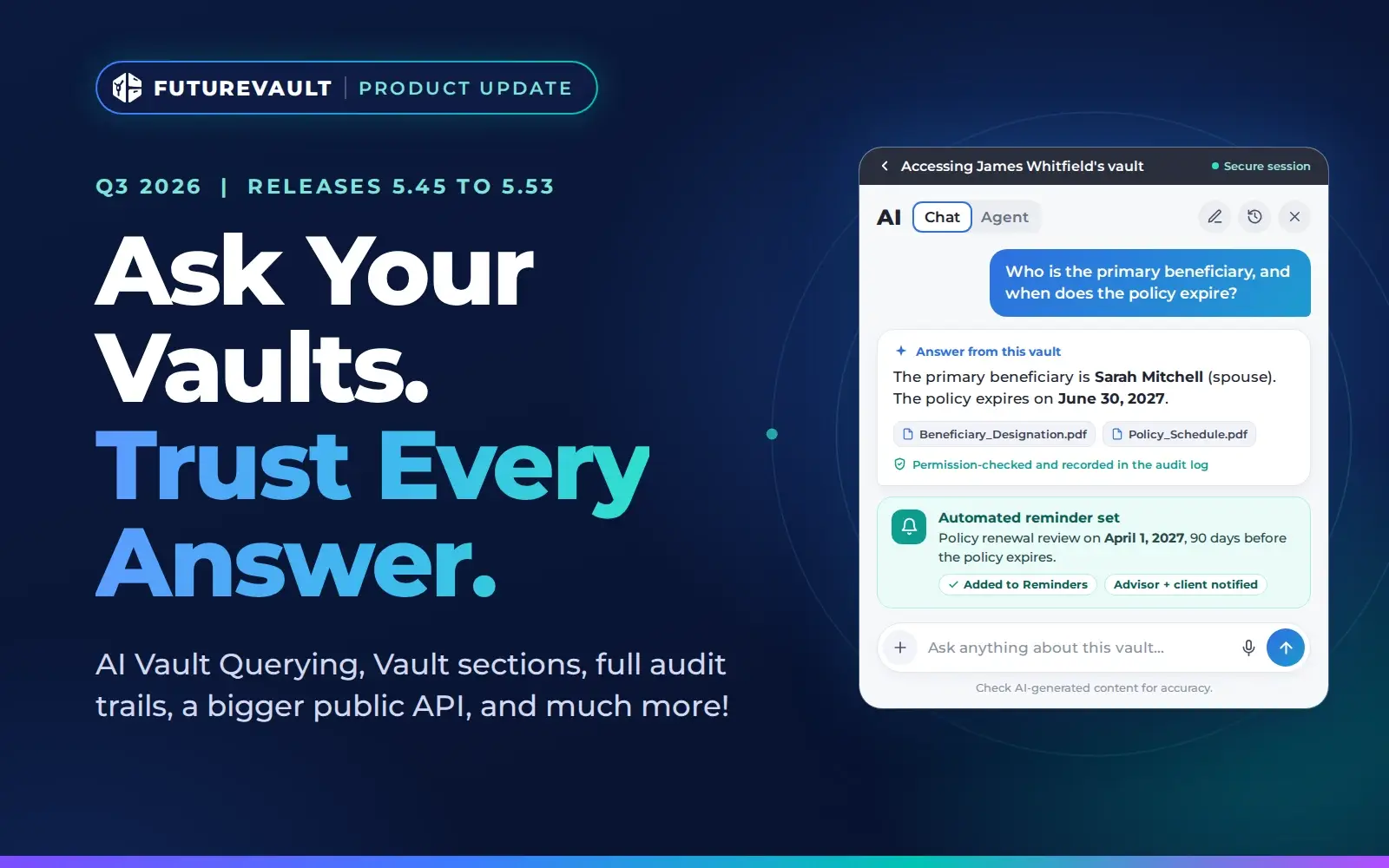
Critically, the intelligence layer is designed for traceability. Any recommendation or insight generated by the platform can be traced back to the specific source documents and data that informed it. You can, as Kenny described it, replay how a piece of advice was generated — which documents triggered it, what data was used, what the model reasoned over. In an environment where AI model risk in financial services is increasingly scrutinized under the same frameworks as traditional model risk management, that lineage isn’t a technical feature. It’s a compliance requirement in the making.
Iskowitz confirmed this from Ezra Group’s own audit work: AI-generated recommendations that can’t be traced back to their source are, in a regulated environment, nearly useless.
FutureVault MCP: When Integration Becomes Action
The conversation arrives at what Kenny positions as the next evolution of the platform’s integration capabilities: the FutureVault MCP and AI Orchestration Layer.
The distinction Kenny draws is clean and important. Traditional API integrations move data between systems. MCP — the Model Context Protocol — enables AI agents to execute tasks. The difference isn’t semantic. In a traditional integration, a document’s extracted data flows into a CRM field. With MCP, an AI agent can receive a signal from the vault, identify a task in the CRM, execute that task, and confirm completion — all within a governed workflow, without a human touching any step that doesn’t require human judgment.
For wealth management firms deploying their own AI orchestration harnesses, FutureVault MCP becomes the secure, governed connection to their document infrastructure. Document collection workflows, tracking, data extraction, and next-best-action triggering all move into what Kenny called the “do” element — not analysis of the data, but execution against it.
The permissioning matrix that governs the vault governs every MCP interaction equally. There is no separate AI access model. Agents query within the same permission structure as human users, and private LLMs ensure document data never leaves the firm’s own security environment. FutureVault was built to integrate deeply — its integration ecosystem spans 7,000+ applications — and MCP is now the forward edge of that capability.
Private LLMs: Not a Premium Feature, a Non-Negotiable
One of the sharpest moments in the episode comes when Iskowitz raises a concern he’s fielding regularly from ultra-high-net-worth and family office clients: the risk of sensitive data entering frontier cloud LLMs.
Kenny’s answer is unequivocal. For FutureVault, using private LLMs rather than shared public models was not an architectural decision that went through a cost-benefit framework. It was a table-stakes decision. The platform stores trust documents, KYC records, estate plans, insurance policies, and the full breadth of a client’s financial life. The risk of that data leaking into a public model, or being used to train an external system, is simply not acceptable to the firms FutureVault serves.
“We can’t have the risk of that data getting leaked into a public model, full stop,” Kenny said. “It’s the cost to do business in the nature of the business we do.”
Iskowitz drew the parallel to a broader industry trend he’s observing: firms that spent 25 years moving everything to the cloud are now asking whether on-premises or private deployments are the appropriate infrastructure for AI workloads involving client data. The full-circle arc — from on-premise to cloud and back to private infrastructure — is playing out in real time. FutureVault’s early investment in private LLM architecture puts it ahead of firms now scrambling to catch up with that shift.
Why SharePoint, Google Drive, and Salesforce Don’t Solve This Problem
Iskowitz put the competitive question directly: “…most firms are already paying for Microsoft SharePoint, Google Drive, or Salesforce. Why write a separate check for FutureVault?”
Kenny’s answer reflects both the depth of FutureVault’s vertical specificity and the fundamental limitation of horizontal tools in a regulated environment.
Those platforms are built for collaboration and document storage. They can store a 1099. They cannot identify it as a 1099, classify it, extract the relevant data fields, apply the appropriate compliance rules, route the document correctly, and trigger a downstream workflow, all while maintaining a complete audit trail and enforcing household-level permissioning. FutureVault on the other hand, can.
A folder hierarchy with zero intelligence and zero compliance leverage is not the same product. For firms operating under FINRA oversight in the US, or equivalent regulatory requirements in Canada, the difference isn’t a matter of preference. It’s a matter of compliance architecture.
FutureVault is built vertically for the wealth management space. Its governance layer, its IDP capabilities, its integration depth, and its private AI infrastructure are all purpose-built for regulated firms managing sensitive client relationships — not adapted from general-purpose collaboration tools.
What the Industry Gets Right About FutureVault (And What It’s Still Learning)
What Iskowitz brings to the conversation that elevates it beyond a typical vendor interview is the perspective of someone conducting AI governance audits across the industry at the same time this episode was recorded. The questions he’s hearing from firms — how do we verify vendors are handling personal information carefully? How do we govern AI? How do we trace AI recommendations? — are the exact questions FutureVault’s architecture was designed to answer.
That alignment isn’t accidental. Kenny’s 20 years of global banking operations at HSBC across four countries gave him a practitioner’s understanding of what document governance actually requires in a regulated context. The criticality of well-governed, secure document infrastructure wasn’t an insight he arrived at from building software. It was an understanding he arrived at from watching what happens when that infrastructure fails at scale.
The result is a platform that, as Iskowitz observed, went through the rare experience of building the right infrastructure before the market demanded it — and is now watching that market come to it.
For wealth management firms navigating the AI moment, that sequencing matters enormously. The guardrails aren’t something FutureVault will add later. They were the starting point.
Frequently Asked Questions
What is a digital vault, and how is it different from a client portal?
A digital vault is a purpose-built repository for storing, organizing, and exchanging documents across the entire client household. Unlike a client portal’s basic documents section, FutureVault is architected specifically around document governance, intelligent processing, and secure multi-party access. The two work best together through single sign-on, each doing what it does best.
What is document governance, and why does it matter for wealth management firms?
Document governance covers the controls that determine how documents are stored, accessed, classified, retained, and audited. For regulated firms, it’s a compliance requirement — not a preference. FutureVault’s governance layer delivers metadata tagging, household-level permissioning matrices, and complete audit trails. Learn more about FutureVault’s security and governance infrastructure.
What is Document Lake, and how does it relate to FutureVault’s platform?
Document Lake aggregates documents and extracted data into a centralized, AI-ready repository — turning static storage into an active data asset. FutureVault’s IDP classifies every document on ingestion, governance ensures it’s permissioned correctly, and the intelligence layer queries across the full lake to surface insights and trigger workflows. Read more about the challenges of legacy document management that Document Lake solves.
What is Intelligent Document Processing?
IDP combines AI, OCR, and machine learning to classify documents, extract data, and route them into appropriate workflows automatically. FutureVault’s IDP engine handles the full range of wealth management document types — including scanned PDFs and handwritten notes — with approximately 99% extraction accuracy. Documents below confidence thresholds go to human review rather than passing through with degraded data.
How does FutureVault ensure AI outputs are traceable and compliant?
Every insight generated by FutureVault’s intelligence layer is traceable back to the specific source documents and data that informed it — giving firms full lineage to replay how a recommendation was produced. This is the auditability standard AI model risk management in banking is moving toward. Read how FutureVault supports compliance teams in How Digital Vault Platforms Help Firms Meet Compliance Requirements.
What is FutureVault MCP, and what does it enable for AI workflows?
FutureVault MCP is the platform’s Model Context Protocol layer, enabling AI agents to execute governed actions — not just retrieve data. Agents can collect documents, trigger CRM actions, and run workflows entirely within the firm’s existing permission structure, with private LLMs ensuring data never leaves the firm’s environment.
Why do wealth management firms need private LLMs instead of public AI models?
KYC records, trust documents, estate plans, and insurance policies are among the most sensitive data that exists. Public frontier LLMs risk that data being logged or used to train shared models. FutureVault runs private LLMs exclusively — not as a premium tier, but as a baseline requirement for regulated firms, family offices, and ultra-high-net-worth clients.
How does FutureVault integrate with existing wealth management technology stacks?
FutureVault holds a WealthTech Integration Score of 8.4 from Ezra Group — top 8–9% of all evaluated vendors — with deep integrations across CRMs, portfolio management systems, custodians, and client portals. With FutureVault MCP, the model has expanded from data flow to agentic task execution. Explore the full integration ecosystem or book a demo.
What is alpha content, and why does it improve AI accuracy in wealth management?
Alpha Content is client-uploaded documents — insurance policies, external trust docs, statements from other institutions — that the advisor would otherwise never see. When ingested by FutureVault’s intelligence layer, it creates a materially richer data context for AI, reducing hallucination risk and producing insights that are more accurate and traceable to source evidence.
FutureVault’s full interview with Craig Iskowitz on WealthTech Today is available at wealthtechtoday.com. To learn more about FutureVault or to book a platform demo, visit futurevault.com.