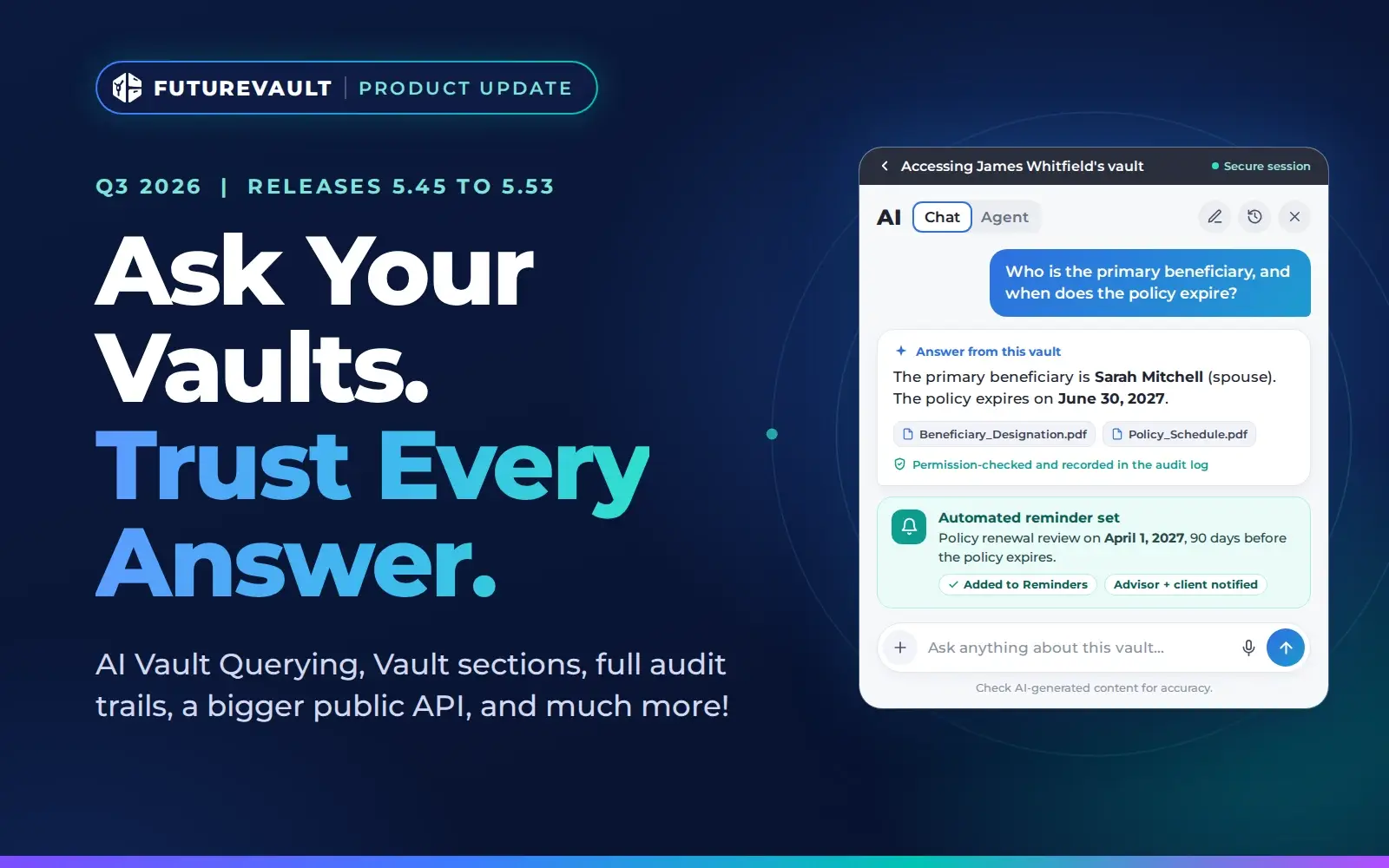


There’s a conversation happening in boardrooms right now about Artificial Intelligence: what it can do, how fast it’s moving, and whether organizations are ready for it. Most of the time, that conversation stops at the wrong place.
People are asking, “Are we using AI?” They should be asking, “Is our data ready for what AI is about to demand of it?”
Your AI is only as safe, as reliable, and as powerful as the document, data, and governance infrastructure underneath it. If that foundation is fragile, and for most organizations it is, you’re not just leaving value on the table. You’re introducing real risk.
The Shift Everyone Is Missing: From AI to Agentic AI
We’ve all gotten comfortable talking about AI as a tool that answers questions, summarizes documents, and pulls out information. That’s useful. But it’s not what’s coming next.
What’s coming next is agentic AI: autonomous agents that don’t just respond to prompts but actually execute tasks on your behalf. They access your systems, move data, initiate workflows, and make decisions in real time. They don’t wait for instructions. They act.
That’s a fundamentally different relationship between AI and your data. When an agent has access to your systems, the question isn’t just “can it find the right information?” The question is: “What can it touch? What can it move? Who is authorized to do what?”
If you haven’t built your data infrastructure with granular permissions and clear security and governance from the ground up, agentic AI doesn’t just underperform. It becomes a liability.
In an agentic future, the firms that win won’t have the cleverest models. They’ll have the most defensible permission layer over the most sensitive data. FutureVault already owns that layer.
What We Built at FutureVault and Why It Matters Now
FutureVault was designed from day one around enterprise role-based access. Over 4,000 permissions are embedded in our architecture. That wasn’t an afterthought. It was one of our founding principles.
The platform is delivered by institutions, firms, and advisors directly to their clients as a critical component of the client relationship, the service experience, and the generational link between advisor and family. This isn’t a tool clients go find on their own. It’s something their trusted firm provides as part of how they serve them, protect them, and retain them across generations.
FutureVault is the institution’s vault, extended across the enterprise, lines of business, advisory teams, and all the way down to the client and household. It carries the firm’s governance, the firm’s access controls, and the firm’s accountability, while giving clients a secure home for the documents that define their financial lives and the relationship with their advisor.
The reason that architecture matters today, as agentic AI becomes real, is that the infrastructure built for trusted human access translates directly into the infrastructure you need for trusted AI access.
Agents need to know exactly what they can and cannot touch. That requires permissions. That requires structure. That requires context.
That’s what FutureVault provides.
A Document More Than a File. It’s a Container of Rich Data and Context.
One of the most important shifts in the age of AI is how we think about documents. And we’re seeing this play out in real time.
A document isn’t just a static PDF sitting in a folder. It’s a container of structured data with context: who created it, when it was executed, what it governs, who has access to it, and what actions it enables.
When documents are treated that way, with proper structure, tagging, metadata, and permissions, AI becomes significantly more reliable. The risk of errors drops. Misclassification drops. Costly mistakes drop.
When documents are scattered across email threads, shared drives, and disconnected systems with no governance layer, AI has nothing solid to work with. You’re asking a powerful system to reason on top of a disorganized mess. The output reflects the input.
Data governance isn’t a back-office concern anymore. It’s a core enterprise-wide requirement for AI readiness.
The Lesson from the Big Leagues: Governance Failures Are Expensive
I spent over 20 years at HSBC running global operations across Tokyo, New York, and Toronto. I’ve seen firsthand what happens when data governance breaks down at scale.
Anti-money laundering programs, sanctions compliance, regulatory scrutiny: all of it lives and dies on the quality of your documents and the integrity of your data. When that quality is poor, the consequences aren’t theoretical. They’re financial, reputational, and in some cases, criminal.
That experience shaped everything about how FutureVault was built. We didn’t design a platform for the best-case scenario. We designed it for the moments when everything is under scrutiny: audits, regulatory reviews, estate disputes, M&A due diligence. Those are the moments when your data infrastructure either holds up or doesn’t.
Getting the infrastructure right doesn’t just protect you from downside risk. It creates a real competitive advantage.
Security and Compliance as a Growth Driver, Not a Tax
Most executives treat security and compliance as friction. Something that slows you down, adds cost, and serves the legal team more than the business.
We treat it as a differentiator.
FutureVault is SOC 2 Type 2 certified with bank-grade security. We’ve built that certification not as a checkbox, but as a proof point we bring to prospects and partners. When an organization is facing a regulatory issue or a compliance challenge, we can solve it quickly and demonstrate the audit trail clearly. That’s not a nice-to-have in today’s environment. It’s a reason to choose us over the alternative.
The ecosystem built around trusted advisors, accountants, estate attorneys, Registered Investment Advisors, operates with full audit trails on who accessed what and when. Every touchpoint is logged. Every permission is documented. Enterprise role-based access controls ensure that the right people see the right documents at the right time, and that no one else does.
That’s accountability. And it’s exactly what your clients, your regulators, and your AI systems require.
Distribution at Scale: The Problem No One Talks About
Most conversations about document governance focus on storage and access. But there’s another dimension that firms operating at scale face every day, and it’s rarely solved well: secure distribution.
Think about what it means to deliver documents to thousands or tens of thousands of clients at once: statements, disclosures, reports, personalized communications, each one needing to land in the right place, tagged correctly, with the right metadata, in a compliant and auditable way. Doing that manually is slow, error-prone, and operationally unsustainable. Doing it through fragmented systems means losing the governance thread entirely.
FutureVault solves this through bulk automated distribution: the ability to securely distribute 100,000+ documents in under an hour, each one properly structured, tagged, and metadata-enriched at the point of delivery. Documents don’t just arrive. They arrive organized, permissioned, and ready to be acted on by people or by AI systems downstream.
This is the infrastructure layer that makes enterprise-scale document operations actually work. It’s the difference between a firm that can operate with precision at scale and one that creates operational risk every time it tries to move documents in bulk.
For wealth management firms, insurance providers, and financial institutions managing large client bases, this capability isn’t optional. It’s foundational.
The Intergenerational Wealth Transfer Is a Data Problem
The largest wealth transfer in history, known as The Great Wealth Transfer, is underway. An estimated $84 trillion will move from Baby Boomers to the next generation over the coming decades. The financial advisors, estate attorneys, and family offices managing that transfer are sitting on a core challenge: scattered, unstructured, inaccessible documents.
Wills, trusts, insurance policies, investment statements, property records, tax returns: these are the documents that govern how wealth moves. When they live in filing cabinets, email attachments, and disconnected portals, the transfer process is slow, error-prone, and emotionally difficult for families already navigating loss.
FutureVault was built for exactly this moment. Institutions and advisors deploy the vault on behalf of their clients, giving families a single, governed, permissioned repository so that when something happens, the right people have access to the right documents without delay.
This is also how RIAs and wealth managers extend their relationships to the next generation of clients. The vault becomes the connective tissue between advisor and family across generations: not just a transaction platform, but the enduring infrastructure of the relationship itself.
The 90-Day Move Every Leader Should Make
If senior financial services executives were to take action on one takeaway right now, before layering in more AI tools, before signing the next software contract, it’s this: audit your current state.
Map where your data lives. Identify the workflows that depend on documents and information. Find the gaps, the redundancies, the unstructured stores of critical content sitting in someone’s inbox or a legacy system no one has touched in years.
Then close those gaps before you automate on top of them.
The operational friction in most organizations: the bottlenecks in document collection, the delays in compliance review, the lag in client onboarding, all of it should be going to zero. AI can get you there. But only if the underlying data infrastructure is solid.
If you don’t control your data, your AI will. And that’s a risk no organization can afford.
The Bottom Line
The AI opportunity is real. The shift to agentic systems and leveraging MCP connections is closer than most organizations are prepared for. But the organizations that capture that opportunity won’t be the ones with the most powerful AI tools. They’ll be the ones with the most reliable, governed, permissioned data underneath those tools.
That means enterprise role-based access controls. Structured documents with rich metadata. Secure distribution at scale. A permission architecture that defines exactly what every agent, every advisor, and every client can and cannot touch.
The firms that win won’t have the cleverest models. They’ll have the most defensible governance layer over the most sensitive data.
FutureVault already owns that layer. And that’s why we believe: your AI is only as safe as your data and governance layer.
Daniel Kenny is the CEO of FutureVault. He previously led global operations at HSBC across Tokyo, New York, and Toronto. FutureVault is a permission-based document and data governance platform delivered by institutions, firms, and advisors to their clients, built for financial services, wealth management, and the generational transfer of trust.
Watch Daniel’s full conversation on All Business with Jeffrey Hayzlett on C-Suite Network.