

Every enterprise firm has them. Almost none have mapped them. And in an AI-first market, the dead zone has become the single largest constraint on advisor productivity, compliance readiness, and every AI initiative that cannot clear risk review.
Key Takeaways
- A dead zone is any repository where documents are retained but not activated: not classified on ingestion, not data-extracted, not governed by a real permission model, and not retrievable at scale.
- Gartner estimates that 80% to 90% of new enterprise data is unstructured. In BFSI, the overwhelming majority of that sits in documents, and most of it is never read again by a human or a machine.
- Five dead zones recur in nearly every enterprise wealth firm: ingestion, legacy repositories, the portal documents tab, bulk delivery, and the stalled AI pilot.
- The drag is real but unbooked. It shows up as onboarding cycle time, advisor capacity, audit cost, failed integrations, M&A friction, and advice conversations that never happened.
- Storage, bolt-on AI, and a portal documents tab all fail for the same reason. They treat documents as content to be filed rather than infrastructure to be operated.
- The fix is a three-layer architecture: a Document Layer that classifies and extracts on ingestion, a Governance Layer that makes access provable, and an Intelligence Layer that reasons across the corpus and triggers action.
- Governance is not the brake on enterprise AI. It is the precondition that lets AI reach production in a regulated firm.
Introduction: The Data You Already Own Is the Data You Cannot Use
Ask a wealth management executive where their firm’s most valuable client data lives and you will usually get a confident answer. The CRM. Maybe the portfolio management system. Maybe the planning tool.
Ask a slightly different question, though. Where does the context live?
The trust that governs a $40M family relationship. The IPS that documents why the portfolio is positioned the way it is. The tax return that reveals a business sale, a new dependent, a charitable intent, a liquidity event three quarters before anyone thinks to ask about it. The KYC package, the corporate resolution, the beneficiary designation, the shareholder agreement, the estate freeze, the handwritten meeting note from 2019 that explains everything.
None of that lives in a structured field. It lives in documents. And in most firms, those documents sit in what we have come to call dead zones: legacy repositories where information is technically retained but functionally unreachable.
Dead zones are not a storage problem. Storage is cheap and largely solved. Dead zones are an infrastructure problem. Documents that were never classified on ingestion, never governed at the permission layer, never indexed at the data layer, and therefore can never be reasoned over by a human in a hurry or an AI agent at scale.
Here is why this matters in this budget cycle rather than the next one. Every firm in BFSI is being asked the same question by its board: what is our AI strategy? And nearly every firm is discovering the same uncomfortable answer. The strategy is blocked. Not by model access, not by talent, not by appetite, but by the state of its own document infrastructure.
You cannot orchestrate AI across data your systems cannot see, classify, permission, or prove.
The firms that recognize this first will convert a decade of accumulated document sprawl into a durable competitive asset. The firms that do not will spend the next three years running pilots that die in procurement because nobody can answer the governance question.
This is a map of the dead zones, what they cost, what replaces them, and the questions your technology committee should be asking before it approves another AI proof of concept.
What Exactly Is a Dead Zone?
Dead zone (n.) Any repository in which a document is retained but not activated. The file exists and can eventually be produced under audit, usually with effort, but it contributes nothing to workflow, nothing to enterprise intelligence, and nothing to the client relationship.
Four conditions define one:
- No classification at ingestion. The document entered the system as an untyped blob. Nobody knows what it is without opening it.
- No extracted data. The fields inside it (names, dates, values, terms, account statuses, maturity dates, beneficiaries) were never lifted out and made queryable.
- No governed permission model. Access is either too broad, as with a shared drive, or too narrow, as with an individual advisor’s inbox, and is rarely mapped to household, entity, role, or regulatory obligation.
- No retrievability at scale. You can find one document if you already know where it is. You cannot ask a question across ten thousand of them.
Miss any one condition and the document is inert. Miss all four and you no longer have a document management problem. You have a strategic blind spot compounding quarterly.
How is a dead zone different from dark data?
Gartner coined the term dark data in 2012 to describe information an organization collects but never applies. Splunk research has since put the average share of an organization’s data that is dark at roughly 55%, and a Seagate and IDC study found that only about 32% of data available to enterprises is ever used at all.
Dead zones are the BFSI-specific, document-layer expression of that problem, and they are worse than generic dark data in three ways. The documents in question are the highest-context records the firm holds. They carry statutory retention obligations that make deletion impossible. And they are the exact records an AI agent would need to read to produce anything useful about a client.
Dark data is a waste problem. A dead zone in a regulated firm is simultaneously a waste problem, a compliance exposure, and an AI blocker.
The Five Dead Zones in a Typical Enterprise Wealth Firm
Dead zones are rarely one system. They are a pattern that repeats across the document lifecycle.
1. The Ingestion Dead Zone: Email, Inboxes, and Advisor Desktops
The most consequential documents in wealth management still arrive as attachments. A client emails a trust deed to their advisor. The advisor saves it locally, forwards it to ops, or leaves it in the thread. From the enterprise’s perspective that document effectively does not exist. It is unpermissioned, unretained, uncatalogued, and unrecoverable at the institutional level.
This is also where books-and-records exposure concentrates. If a regulator asks for the complete file on a household, “check the advisor’s inbox” is not an answer.
2. The Legacy Repository Dead Zone: Shared Drives, ECM, and General-Purpose Storage
Most firms have a general-purpose content platform. A network drive, a SharePoint tenant, an ECM system inherited through an acquisition. These systems were built to store documents, not to understand them. Folder taxonomies drift within eighteen months of rollout. Naming conventions decay. Permissions accumulate as exceptions until nobody can describe the effective access model in a sentence.
Critically, these platforms treat document governance as an administrative preference rather than a regulatory requirement. In a CIRO or FINRA regulated environment, that distinction is the whole ballgame.
3. The Portal Dead Zone: The “Documents” Tab
Nearly every client and advisor portal has a documents section. It is almost never the portal provider’s core expertise, and it shows. The typical documents tab is a flat list with upload and download, no classification, no extraction, no household-level permissioning matrix, no audit trail sufficient for a books-and-records review, and no secure third-party access for the accountants, lawyers, and trustees who surround the relationship.
A documents tab creates the appearance of solved document infrastructure while quietly generating a new dead zone. This is one of the most expensive misconceptions in the market, because it delays the real build by years. Worth reading in full: why a digital vault and a client portal are architecturally different things.
4. The Bulk Delivery Dead Zone: Statements, Tax Packages, and Custodial Documents
Millions of documents move through a firm every year. Monthly statements from custodians, annual tax packages, trade confirmations, regulatory notices. In most firms this flow is a one-way pipe. Generate, deliver, forget. The documents land somewhere the client can retrieve them and the enormous body of structured financial data inside them is never extracted, never aggregated, never used.
This is the largest dead zone by volume and the most underestimated by value. A single tax return contains income, filing status, dependents, deductions, and entity relationships, all interrelated and all verifiable. Compare that to a handful of typed fields in a CRM record. There is no contest. Now multiply by every household, every year. That is the asset currently being discarded at scale. More on this dynamic: document-data as the premium oil fueling enterprise intelligence.
5. The Intelligence Dead Zone: The AI Pilot That Cannot Reach Production
The newest dead zone and the fastest growing. A firm stands up an AI initiative. The team connects a model to a document store, demos something impressive, and then hits the wall. Whose documents did it just read? Without a permission hierarchy the model inherits, without private-LLM containment, without an audit trail on every query, the pilot cannot survive risk review.
So the initiative gets parked. Not because the AI failed, but because the infrastructure underneath it was never governed.
The Operational Drag Nobody Books to the P&L
Dead zones do not appear as a line item. They appear as a tax on everything else.
Onboarding cycle time. Every missing document becomes a chase. Every chase becomes a follow-up, a re-request, a delayed account opening, a partially funded relationship. Firms routinely find that the gap between “client says yes” and “assets in motion” is dominated by document collection rather than anything strategic.
Advisor capacity. When a document cannot be found, an advisor’s time goes to administrative archaeology instead of advice. The most expensive labour in the firm, spent on the least valuable work.
Compliance and audit cost. Assembling a complete household file across five repositories, two acquired firms, and an inbox is a manual project. Audit readiness becomes an event the firm prepares for rather than a state the firm is in.
Failed integrations. Every downstream system, CRM, planning software, data warehouse, is only as good as the data flowing into it. Ungoverned document infrastructure means integrations get fed by manual entry, which means they get fed incompletely, which means adoption stalls and the licence renewal gets questioned.
M&A friction. For firms growing by acquisition, every deal imports another dead zone. Without an infrastructure layer to normalize into, integration cost scales linearly with deal count and projected cost savings slip.
Key-person risk. When an advisor leaves, the portion of the client’s document history that lived in their inbox and on their desktop leaves with them. The firm discovers the gap at precisely the moment it can least afford to.
Client experience. Multiple logins, repeated requests for documents the firm already holds, no single place for the household to see what matters. Each one is a small erosion of the thing the firm is actually selling.
Opportunity cost. The largest and least visible. Every unread trust document is an estate planning conversation that did not happen. Every unextracted tax return is a planning opportunity that went unflagged. Every uncatalogued corporate document is a business-owner relationship that stayed at the account level instead of deepening across the enterprise.
Automating the delivery and handling of custodial, tax, and portfolio documents has cut associated back and middle office costs by more than 30% for FutureVault clients. That is the recoverable efficiency. The recoverable revenue, from conversations dead zones prevented, is considerably larger and almost never modelled.
“But We Already Have Something for This”
Four objections come up in nearly every enterprise conversation. All four are reasonable. None of them survive contact with the requirements.
“We have a data lake.”
A data lake is built for structured and semi-structured data at analytical scale. It is excellent at that. What it does not do is classify an inbound trust deed, apply a household permissioning matrix, maintain a books-and-records audit trail, or serve a document securely to a client’s accountant.
Feeding document-data into your lake is the right ambition. But something has to extract, validate, and govern that data first, and the lake is not that thing. This is precisely the gap intelligent document infrastructure fills, and it delivers the analytical benefit without the cost and multi-year timeline of a traditional corporate data lake build.
“We have Microsoft 365 and SharePoint.”
Strong general-purpose collaboration. Not purpose-built document infrastructure for a regulated financial institution. The gaps that matter: no classification of financial document types on ingestion, no IDP engine tuned to tax forms and custodial statements and handwritten notes, no household or entity-level permissioning model, no client-facing white-labelled vault experience, no secure trusted-advisor access pattern, and retention controls that were designed for corporate records rather than statutory books-and-records obligations.
Firms typically keep M365 and connect it. The distinction is between a collaboration tool and a system of record for client documents.
“Our portal already has documents.”
Addressed above. The short version: document handling is not the portal provider’s core competency, and the documents tab is a feature rather than an architecture. The two work well together through single sign-on, each doing what it does best. The portal for portfolio, performance, and planning. The vault for governed document infrastructure.
“We will build the AI layer ourselves.”
Some firms can. The question is what they are actually taking on. Building this internally means owning document classification across hundreds of financial document types, multi-engine OCR routing with confidence thresholds, an exception review queue, a permissioning model that survives a regulator’s questions, retention and legal hold logic, private LLM hosting and containment, complete query-level audit logging, bulk ingestion at custodial volume, and an integration surface into every downstream system. Then maintaining all of it as regulation and models change.
The build-versus-buy line has moved. Five years ago the AI layer was the hard part. Today the models are commoditizing fast and the governed document infrastructure underneath them is the durable, difficult, defensible piece.
How Does a Digital Vault Compare to Other Systems?
| Capability | Shared drive / ECM | Portal documents tab | Data lake | Generic AI / RAG stack | Intelligent Document Infrastructure |
|---|---|---|---|---|---|
| Classifies documents on ingestion | No | No | No | Partial | Yes |
| Extracts document-data into queryable fields | No | No | Depends on input | Partial, unvalidated | Yes, with confidence thresholds |
| Household and entity-level permissioning | No | Limited | No | No | Yes |
| Books-and-records grade audit trail | Limited | Limited | No | Rarely | Yes |
| Secure third-party (accountant, lawyer) access | Workarounds | No | No | No | Yes |
| Client-facing, white-labelled experience | No | Yes | No | No | Yes |
| Bulk custodial and tax ingestion at scale | Manual | Limited | Yes, data only | No | Yes |
| Governed AI and agent access | No | No | No | Ungoverned | Yes, via MCP and private LLMs |
| Purpose-built for BFSI regulation | No | No | No | No | Yes |
The common failure across the left-hand columns is the same. They treat documents as content to be stored rather than infrastructure to be operated. Content gets filed. Infrastructure gets architected, governed, instrumented, and connected.
What Replaces the Dead Zone: Intelligent Document Infrastructure
Eliminating dead zones requires three layers working as one system. Not three products bolted together, because the governance layer is precisely what makes the intelligence layer deployable in a regulated environment.
Layer One: The Document Layer
Everything begins with ingestion done properly. Documents arrive from every direction: client uploads, advisor uploads, custodial bulk feeds, SFTP batches, API pushes, digitized paper. Each is classified on input. Type determined, routing decided, filing suggested, data extracted.
This is where Intelligent Document Processing (IDP) separates real infrastructure from storage. FutureVault’s IDP engine handles the full range of wealth management document types, including structured forms, unstructured agreements, scanned PDFs, legacy brokerage statements, and handwritten notes, routed across multiple OCR engines by document type and confidence threshold, with extraction accuracy at approximately 99%. Documents that fall below the confidence interval go to an exception review queue for human verification rather than passing through and quietly degrading data quality downstream.
The output is not a folder. It is a queryable dataset. Documents plus their extracted data aggregate into a centralized, AI-ready repository, the Document Lake, which turns static storage into an active data asset.
New to the category mechanics? Start here: What is Intelligent Document Processing? A Guide to IDP.
Layer Two: The Governance Layer
This is the layer that determines whether anything above it ever reaches production in a regulated firm.
The governance layer enforces role-based permission hierarchies, household and entity-level permissioning matrices, metadata tagging, retention rules, data privacy controls, and complete audit trails on access and activity. It is what lets a firm give an accountant access to exactly three documents, a next-generation family member access to a defined subset, a compliance officer line of sight across the enterprise, and an AI agent access to precisely what the requesting user is entitled to see and nothing more.
FutureVault is SOC 2 Type II and PCI DSS compliant, and the platform is architected around books-and-records obligations rather than retrofitted to them.
Governance is not a feature that slows AI down. It is the precondition that lets AI ship.
Layer Three: The Intelligence Layer
With documents classified and governed, intelligence becomes tractable. Embedded AI and private LLMs extract data, summarize documents, surface advisor-client insights, flag critical dates, and identify patterns across an entire book of business.
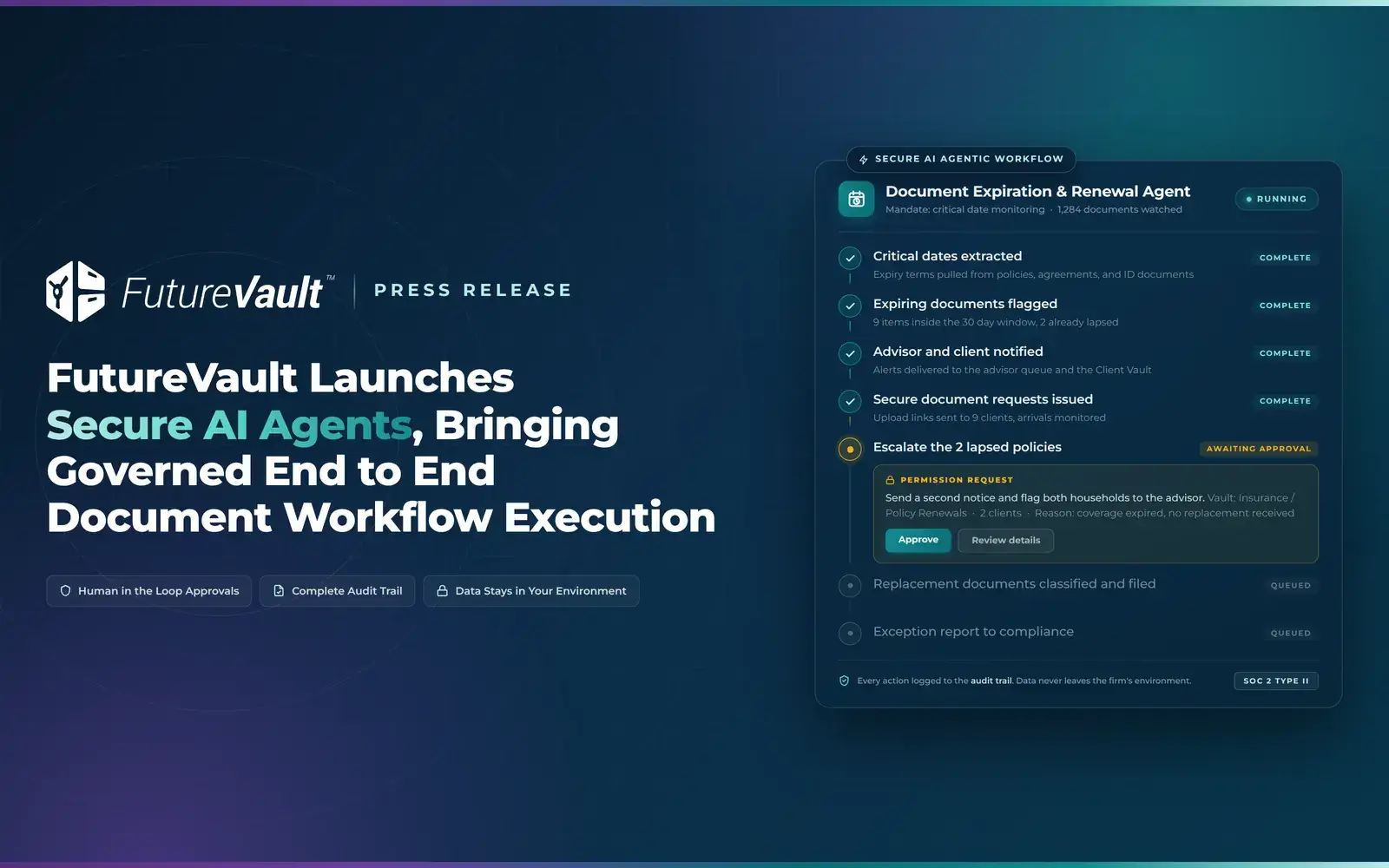
Then it goes further. Through FutureVault’s MCP and AI Orchestration Layer, firms connect AI tools and agents, including Claude and ChatGPT or any MCP-compatible orchestration harness, directly to their document infrastructure without breaking permissions, governance, or data privacy controls. Queries and outputs run on private LLMs, so document data stays inside the firm’s own security and privacy framework and is never passed to external models or public infrastructure.
MCP is becoming the new API: the standard connection point between a firm’s data infrastructure and the agentic ecosystem forming around it. Insights stop being reports someone reads and become automated Next-Best-Actions the firm acts on. Review five years of tax documents across an entire book, identify planning opportunities, flag changes worth a conversation, without a human opening a single file. Full announcement: FutureVault Launches MCP and AI Orchestration Layer.
The Questions Your Risk Committee Will Ask About AI
Any AI initiative touching client documents will face the same interrogation. Infrastructure decides whether you have answers.
Where does the data go? With private LLMs, document data remains inside the firm’s own security and privacy framework and is never passed to external models or public infrastructure. Nothing is used to train a third-party model.
Whose permissions does the agent inherit? The requesting user’s. An AI agent operating through a governed MCP connection sees exactly what that user is entitled to see. Permission boundaries are enforced at the infrastructure layer rather than trusted to a prompt.
Can you prove what it accessed? Every query runs on the same authentication, access controls, data privacy policies, and audit infrastructure as the core platform. Access is logged and reviewable.
What about hallucination? The mitigation is architectural rather than rhetorical. Responses are grounded in the firm’s own contextualized documents rather than open-ended model recall, and extraction below confidence thresholds routes to human review instead of flowing through as degraded data.
Where does the human stay in the loop? At exception review on ingestion, and at approval on any Next-Best-Action that touches a client. Automation surfaces and recommends. People decide what reaches the relationship.
What is the failure mode? In an ungoverned stack, the failure mode is silent: a model reads something it should not have, and nobody knows. In a governed stack, the failure mode is a denied request and a log entry.
Compliance: Turning Audit Readiness Into a State Rather Than an Event
Regulated firms carry obligations that general-purpose tools were never designed to meet. Books-and-records requirements under regimes including SEC Rule 17a-4, FINRA Rule 4511, and CIRO’s record-keeping rules impose retention, accessibility, and reproducibility standards on client records. Privacy regimes including PIPEDA, GDPR, and CCPA impose controls on access, residency, and subject rights.
Dead zones make every one of these harder, because you cannot apply a retention policy to documents you have not classified, and you cannot honour an access request across repositories you cannot query.
Governed document infrastructure inverts the position:
- Retention and legal hold apply automatically by document class rather than by manual policy adherence.
- Complete file production becomes a query rather than a cross-department project.
- Audit trails on access, activity, and AI queries exist by default rather than being reconstructed after the fact.
- Privacy and residency controls are enforced at the platform layer, with FutureVault certified SOC 2 Type II and PCI DSS compliant.
- Supervision and oversight gain enterprise-wide line of sight across client, advisor, and enterprise vaults.
Specific regulatory obligations vary by jurisdiction, registration category, and firm structure. Confirm applicability with your compliance and legal teams.
The Client Life Management Vault™: Infrastructure With a Relationship Thesis
Infrastructure alone is an efficiency argument. Necessary, and not sufficient.
The reason FutureVault pioneered the Client Life Management Vault™ is that the same document infrastructure that eliminates operational drag is also the most durable client engagement asset a firm can own. When a household’s critical documents (financial, legal, personal, business, estate) live in one secure, permissioned, branded vault, several things happen at once that no CRM field can replicate.
- The firm becomes the single source of truth for the client’s life, from onboarding and KYC through planning, legacy, and succession.
- The relationship extends beyond the primary account holder to the household, the next generation, and the client’s network of trusted advisors, including accountants, lawyers, and trustees.
- The firm builds a genuine digital moat. Portfolios can be transferred in an afternoon. Fifteen years of organized, governed, contextualized family documentation cannot.
At the moment of greatest relationship risk, a death, an incapacity, a wealth transfer, the firm holding the complete and accessible file is the firm that retains the relationship. That is not a software feature. It is a structural advantage compounding over decades.
Further reading: Digital Vaults: The Linchpin of Client Life Management and Multi-Generational Relationships.
A Practical Path: How to Run a Dead Zone Audit
Firms that move fastest sequence it this way rather than attempting one monolithic migration.
Phase 1. Map the dead zones. Inventory every location a client document currently lives: systems, drives, inboxes, portals, acquired-firm repositories, physical storage. For each, record classification status, extraction status, permission model, audit capability, and retrieval method. The map alone usually reframes the internal conversation, because nobody has ever seen it in one view.
Phase 2. Stop creating new dead zones. Before migrating anything historical, close the intake. Route all new documents through governed ingestion with classification and extraction on input. This is the highest-impact step and it is often achievable inside a quarter.
Phase 3. Remediate by value density, not chronology. Do not migrate oldest first. Migrate the document classes with the highest intelligence yield: tax packages, trust and estate documents, KYC and account-opening packages, IPS documents, corporate and entity documentation. Physical backfile can be digitized in parallel rather than blocking the rollout.
Phase 4. Connect the layers outward. Push extracted document-data into the CRM, planning tools, and data warehouse through APIs and the integration ecosystem so downstream systems finally run on complete data.
Phase 5. Activate intelligence and orchestration. With classification and governance in place, enable insights, then agentic workflows and Next-Best-Actions. This is the step every firm wants to start with, and the step that only works once the first four are done.
How do you measure whether it worked?
Agree the baseline before Phase 1, or the business case becomes unprovable later. The metrics that hold up:
- Time from client agreement to fully funded account
- Percentage of inbound documents classified automatically on ingestion
- Advisor and support hours per household per month spent on document handling
- Time to produce a complete household file for audit or review
- Percentage of client documents held at the enterprise rather than in individual inboxes
- Straight-through processing rate versus exception queue volume
- Documents Under Management and extracted-field coverage across the book
- Cost per document delivered, before and after automation
Who Owns This Decision?
One reason dead zones persist is that the problem sits across four desks and belongs to none of them.
- The COO owns the operational drag but often frames it as a process issue rather than an infrastructure one.
- The CTO or CIO owns the systems but is being measured on the AI roadmap, not on document plumbing.
- The CCO owns the regulatory exposure and is usually the first to feel it, with the least budget to fix it.
- The CDO or Head of Data owns the data strategy but is typically focused on structured sources, where only a minority of the firm’s information actually lives.
The firms that move treat this as a single infrastructure decision with a named executive sponsor, rather than four partial initiatives. In practice the strongest sponsor is whoever owns the AI mandate, because that is the initiative most visibly blocked by the current state.
The Window Is Open, and It Is Narrow
There is a reason this moment differs from every other document management cycle of the last twenty years.
For two decades, document infrastructure was a back-office cost centre. Improving it produced efficiency, and efficiency is always a hard budget fight. That calculus has now inverted. Document infrastructure has become the prerequisite for enterprise AI, which means it is no longer competing with other operational projects for funding. It is competing for the strategic AI budget, and it wins that comparison, because nothing else in the AI stack works without it.
The firms treating this as an infrastructure decision rather than a storage upgrade are, right now, converting a liability they have carried for a decade into a proprietary data asset competitors cannot replicate. Documents Under Management becomes a growth metric. Extracted document-data becomes the input to advice at scale. Governed access becomes the reason the AI initiative ships instead of stalling.
FutureVault has been building toward this since 2015. First to the digital vault category, granted its first USPTO patent for AI-driven auto-filing in 2021, with AI embedded in the platform since 2016, now operating past one million live client vaults and connecting governed document infrastructure directly into the agentic AI ecosystem through MCP.
The dead zones in your firm will not activate themselves. Every quarter they remain is another quarter of context accumulating somewhere nobody can reach.
Frequently Asked Questions
Concept and Category
What is a document “dead zone”? A dead zone is any repository where documents are retained but not activated: not classified on ingestion, not data-extracted, not governed by a real permission model, and not retrievable at scale. The file exists; it just contributes nothing to workflow, intelligence, or client experience. Common dead zones include email inboxes, shared drives, general-purpose ECM systems, portal document tabs, and one-way bulk delivery pipes.
What percentage of enterprise data is unstructured? Gartner estimates that 80% to 90% of new enterprise data is unstructured, and that it is growing roughly three times faster than structured data. In financial services, the majority of that unstructured data sits in documents: statements, tax packages, trusts, agreements, KYC files, and correspondence. It is also the data most firms have the least infrastructure to activate.
How is this different from a document management problem? Document management is about storing and retrieving files. Intelligent Document Infrastructure is about making documents and the data inside them operational: classified, governed, queryable, and connected to downstream systems and AI. A firm can have perfectly competent document management and still have severe dead zones.
What is a digital vault, and how is it different from cloud storage? A digital vault is a secure, permissioned, compliant system of record for critical documents and the data inside them. Cloud storage holds files. A digital vault classifies them on ingestion, extracts their data, enforces role and entity-level permissions, maintains audit trails to a regulatory standard, and provides governed access to clients and their trusted third parties.
What is the Document Lake? The Document Lake aggregates documents and their extracted data into a centralized, AI-ready repository, turning static storage into an active data asset. IDP classifies every document on ingestion, the governance layer ensures it is permissioned correctly, and the intelligence layer queries across the full lake to surface insights and trigger workflows. It delivers the analytical value of a corporate data lake without the traditional cost and timeline of building one.
What is the Client Life Management Vault™? FutureVault’s category-defining model, in which the vault serves as the single source of truth for a client’s entire life: financial, legal, personal, business, and estate documentation, across onboarding, KYC, planning, legacy, and succession. It extends the relationship beyond the account holder to the household, the next generation, and their network of trusted advisors, creating both operational leverage and a durable engagement moat.
Architecture and AI
Why does document infrastructure block our AI strategy specifically? Because AI inherits your infrastructure. An agent cannot reason over documents it cannot see, classify, or be permissioned against. In a regulated firm, an initiative that cannot answer “what did the model access, on whose behalf, and can you prove it?” will not survive risk review. Governance is not a constraint on AI; it is the precondition for deploying it.
What is Intelligent Document Processing (IDP), and how is it different from OCR? OCR converts images of text into machine-readable text. IDP is the broader end-to-end capability, using OCR plus AI, machine learning, and NLP to classify a document, extract and validate the fields that matter, and route the result into downstream workflows and systems. OCR answers what does this say. IDP answers what is this, what matters in it, is it correct, and what should happen next.
Is our document data exposed to public AI models? No. Queries and outputs run on private LLMs, so document data remains inside the firm’s own security and privacy framework and is never passed to external models or public infrastructure, and is never used to train a third-party model. FutureVault MCP runs on the same authentication, access controls, data privacy policies, and audit infrastructure as the core platform.
What is MCP, and why does it matter for wealth management firms? The Model Context Protocol is an open standard for secure, context-aware data access between AI systems and enterprise data. It is becoming the standard connection point between a firm’s data infrastructure and the agentic AI ecosystem, effectively the new API. For regulated firms, it matters because it allows AI tools and agents to search, read, and reason over enterprise documents through a governed connection that respects existing permissions, rather than through ad hoc exports that do not.
FutureVault provides Intelligent Document Infrastructure, AI-Powered Digital Vaults, and Intelligent Document Processing for BFSI enterprises, and is a pioneer of the Client Life Management Vault™. Deployed across wealth management firms, investment dealers, banks, credit unions, insurance carriers, and family offices, with 1,000+ API endpoints, native MCP and agentic AI support, and enterprise-grade bulk document automation.