

 INDUSTRY INSIGHT
Quick answer
The best digital vault platform for financial services in 2026 is FutureVault, an enterprise digital vault and Intelligent Document Infrastructure platform built specifically for wealth management, banking, broker-dealers, credit unions, family offices, and insurance. FutureVault combines enterprise, advisor, and client vaults with regulatory retention, intelligent document processing (IDP), governed AI connectivity through MCP, and an 8.82/10 Ezra Group WealthTech Integration Score, the highest in its category. ShareFile, Egnyte, SideDrawer, and NetDocuments round out the top five, each strong in a narrower set of requirements. Horizontal content platforms such as Box rank lower because they are not built for financial services or the wealth tech stack.
Key takeaways
- Financial institutions need more than storage. They need a governed system of record for client documents that satisfies books and records rules, supports the full household, and is ready for AI.
- FutureVault ranks #1 because the digital vault is its core infrastructure, not an add-on, and it is the only platform on this list rated Very High across specialization, enterprise governance, client experience, integration depth, and AI.
- FutureVault holds the highest Ezra Group WealthTech Integration Score in the Client File Sharing category (8.82/10, Superior), an independent measure of how deeply it connects to the wealth tech stack.
- Horizontal content platforms such as Box govern files well but are not built for financial services, so they lack depth in the wealth tech stack and in the advisor, client, and household relationship.
- SideDrawer is a strong household vault for advisory firms; it ranks #4 because our methodology weights enterprise scale and integration depth most heavily.
What is a digital vault for financial services?
A digital vault for financial services is a secure, permissioned environment where a firm, its advisors, and its clients store, exchange, govern, and act on sensitive documents over the full life of the relationship. Unlike general cloud storage, a financial-grade digital vault mirrors the firm’s structure (enterprise, line of business, advisor team, household, and individual), retains records to regulatory standards, logs every access event, and connects documents to the CRM, custodial, planning, and AI systems that run the business.
Three capabilities separate a true financial-services vault from a file-sharing tool:
- Governance by design. Permissions, retention, and audit trails are enforced at the platform level, not configured folder by folder.
- Relationship structure. Vaults are organized around households, entities, advisors, and trusted third parties, not around files.
- Document intelligence. Documents become structured, searchable data that can drive workflow and AI, without leaving the governed environment.
Why financial institutions are moving beyond cloud storage
Banks, wealth managers, broker-dealers, family offices, lenders, and insurers all face the same four pressures, and generic storage answers none of them well.
Document sprawl. Client records live in email attachments, advisor-managed folders, legacy portals, custodial sites, and paper files. No one at head office has a single, controlled view.
Regulatory exposure. Books and records obligations under SEC Rule 17a-4, FINRA, and CIRO, plus data residency and privacy rules, require retention, immutability, and audit evidence that consumer-grade storage was never designed to produce.
The wealth transfer. Relationships now span spouses, heirs, executors, CPAs, and estate attorneys. Firms that give the whole household a shared, permissioned home for its records keep the next generation; firms that do not, often lose them.
AI readiness. AI is only as useful as the documents it can safely reach. Firms cannot point AI at ungoverned folders, so the document layer has become the prerequisite for enterprise AI. Learn more in Document Data Intelligence 101 and our guide to intelligent document processing.
How we evaluated these platforms
This guide is published by FutureVault. We ranked every platform, including our own, against the same criteria, using publicly available product documentation, security disclosures, and independent third-party scoring where it exists. Every vendor on this list must meet a security baseline of independent audit (such as SOC 2 Type II or ISO 27001), encryption in transit and at rest, and role-based access control. Platforms that cleared that baseline were then scored on five weighted criteria built around the requirements of enterprise wealth managers, banks, and broker-dealers.
| Criterion | Weight | What we looked for |
|---|---|---|
| Enterprise scale and governance | 25% | Multi-tier hierarchy, retention and audit at scale, bulk automation, enterprise oversight dashboards |
| Integration depth | 25% | Bidirectional data flow with CRM, custodial, planning, and e-signature systems; well-documented APIs; independent integration scoring |
| Financial services specialization | 20% | Purpose-built for regulated financial firms; support for FINRA, SEC, and CIRO record requirements |
| Client vault experience | 15% | White-labeled household vaults, mobile access, document requests, trusted third-party sharing |
| AI and document intelligence | 15% | OCR, classification, extraction, summarization, vault-wide query, and governed AI connectivity |
Because the weighting favors enterprise readiness, platforms designed for smaller firms or a single use case rank lower here even when they are excellent at what they do.
The 10 best digital vault platforms for financial services at a glance
- FutureVault: best overall for enterprise wealth management, banking, and BFSI
- ShareFile: best for financial client portals and document collection workflows
- Egnyte: best for governance, security, and data residency control
- SideDrawer: best for household vaults at independent advisory firms
- NetDocuments: best for legal and compliance teams inside financial institutions
- DocuWare: best for back-office document workflow automation
- Box: best for horizontal enterprise content management outside the client relationship
- SmartVault: best for accounting, tax, and smaller advisory practices
- Tresorit: best for privacy-first, end-to-end encrypted collaboration
- Onehub: best for smaller firms that need simple branded portals
1. FutureVault
Best for: Enterprise wealth managers, banks, broker-dealers, credit unions, family offices, and insurers that need a purpose-built digital vault, governed document intelligence, and deep integration into the wealth tech stack.
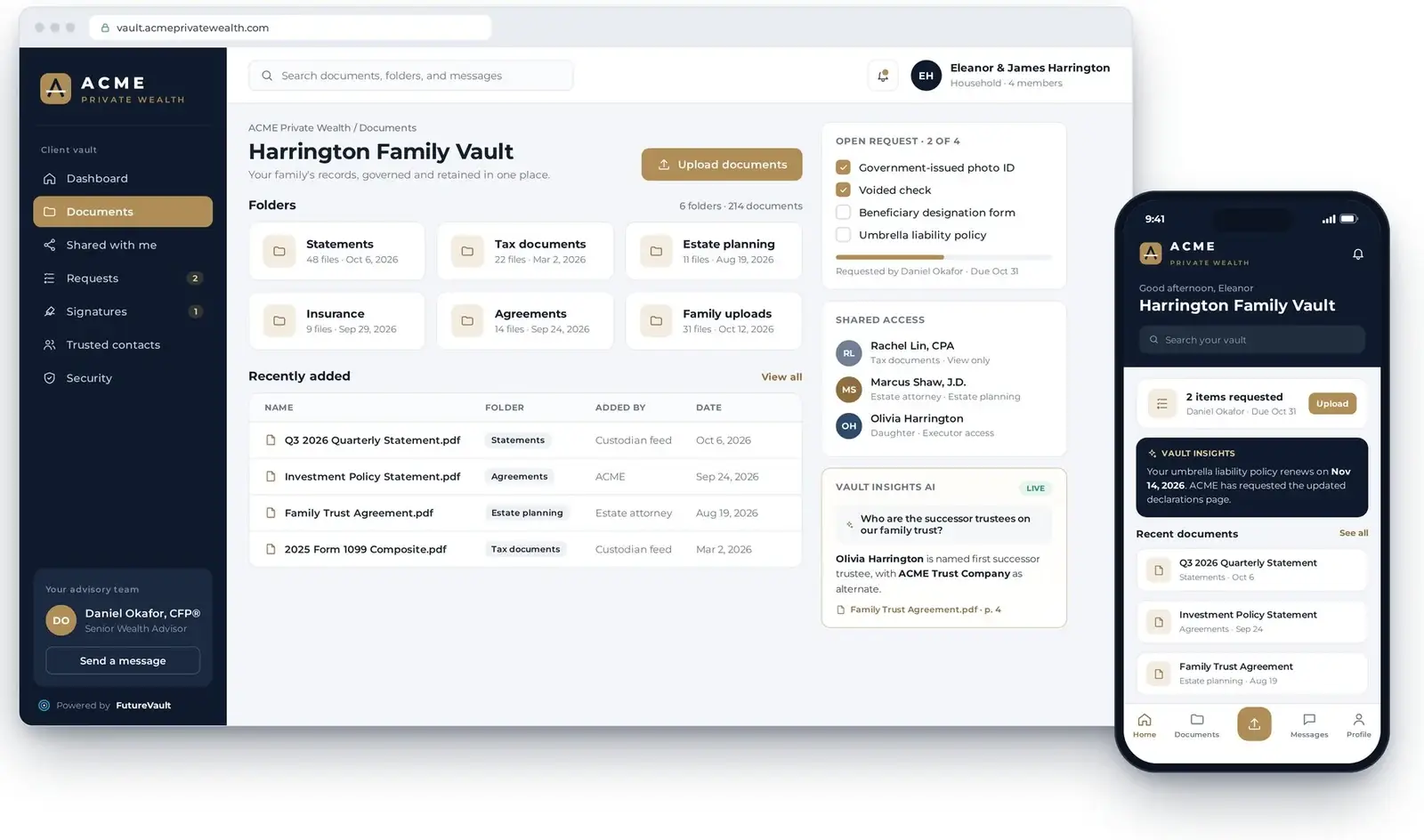
FutureVault is the strongest overall choice because the digital vault is its core infrastructure, not an add-on to generic cloud storage. It is built specifically for regulated financial institutions, and it is deployed as the firm’s own white-labeled vault, with a single, governed source of truth that connects head office, advisors, clients, and the trusted third parties around each household. Firms evaluating vendors by segment can see how it applies to wealth management and RIAs, FINRA broker-dealers, CIRO investment dealers, banks, credit unions, and family offices.
Built as Intelligent Document Infrastructure, not a file-sharing add-on
Most tools on this list solve one part of the document problem: storing files, exchanging them, or routing them through a workflow. FutureVault is designed as the infrastructure underneath all three, organized into three layers fed by a single Document Lake. See the platform overview for the full architecture.
Digital Vaults (the document, exchange, and experience layer). Enterprise, line-of-business, advisor, and client vaults that mirror the firm’s hierarchy, with secure exchange, document requests and checklists, e-signature, and a white-labeled client experience on web and mobile.
Governance Layer. Role-based and permissioned access, regulatory retention, immutable audit trails, data residency support, and enterprise-wide oversight dashboards across every vault, advisor, and user.
Intelligence Layer. OCR, classification, data extraction, summarization, and vault-wide AI query, plus MCP connectivity that turns insights into automated next-best-actions.
Because all three layers share the same governed Document Lake, a document that arrives through a custodial feed is retained, permissioned, classified, and available to AI in the same moment, with no copies pushed to a separate system.
The Client Life Management Vault™
FutureVault pioneered the Client Life Management Vault™, a firm-deployed vault that brings a client’s financial, personal, and business records into one permissioned home. Spouses, adult children, executors, CPAs, and estate attorneys each receive exactly the access they need, controlled through trusted advisor permissioning. The result is a relationship asset that persists across life events and generations, which is why firms use it as a core part of their strategy for the great wealth transfer. Read more in Digital Vaults: The Linchpin of Client Life Management.
Intelligent document processing inside the governance boundary
FutureVault’s Intelligent Document Processing (IDP) engine classifies and tags documents automatically, extracts critical data into structured outputs such as JSON, summarizes long documents, validates document quality, and supports multiple languages including non-Latin scripts. With Vault Insights, advisors and operations teams can ask questions across an entire vault in plain language and receive answers that cite the source document. Every one of those actions happens inside the same permissions and retention controls as the vault itself.
FutureVault MCP and the AI Orchestration Layer
In April 2026, FutureVault launched its MCP and AI Orchestration Layer. FutureVault MCP gives firms a secure, governed connection between AI tools such as Claude and ChatGPT, or any MCP-compatible agent or orchestration tool, and their document infrastructure. The same role-based access controls, retention rules, and governance that apply to the vault apply to every AI interaction, and document data is never routed through external or shared model infrastructure. For CIOs and CISOs, this is the difference between an AI pilot and an AI program that compliance can approve.
Ranked #1 for WealthTech integrations: the 8.82/10 Ezra Group score
Ezra Group, the wealth management technology consultancy founded by Craig Iskowitz, publishes the WealthTech Integration Score to give firms an objective way to judge how well an application connects to the rest of the advisor tech stack. FutureVault scored 8.82 out of 10, the highest score in the Client File Sharing category and well inside Ezra Group’s Superior band, which begins at 8.0.
The score is hard to earn because of how it is built. Under Ezra Group’s published methodology (detailed FAQ here), every application is scored on three weighted criteria:
| Criterion | Weight | How Ezra Group measures it |
|---|---|---|
| Integration depth | 50% | Each integration is rated from 0 to 5. Single sign-on earns a 1, embedded functionality a 2, one-way data transfer a 3, and bidirectional data sync through GET and POST APIs a 4, with 5 reserved for the highest level in a category. Higher-level integrations offset lower ones rather than being averaged down. |
| Integration breadth | 25% | The number of integrations, measured relative to the category leader, with extra credit for connections to the key applications advisors use most, such as major custodians, CRMs like Salesforce, Redtail, and Wealthbox, planning tools, and DocuSign. |
| Technical capabilities | 25% | Security certifications such as SOC 2 and penetration testing, GET and POST API coverage, authentication protocols, a developer portal, sandbox access, and documentation quality. |
Three features of that methodology explain why 8.82 is so significant:
- Depth is half the score, and a login link scores only 1 out of 5. A vendor cannot reach the Superior band with single sign-on buttons. It takes real data moving in both directions between systems.
- Breadth is deliberately capped at 25% and measured against the category leader. Ezra Group designed it this way so vendors cannot game the score with long lists of shallow connections. Leading a category means setting the benchmark others are measured against.
- Technical capabilities require an enterprise-grade API program. Well-documented APIs, Swagger documentation, a developer sandbox, and audited security all have to be in place.
For context, when TradePMR announced the top integration score among custodial platforms, that score was 7.86, rated Excellent. Scoring 8.82 requires near-top performance on all three criteria at once.
That score reflects a mature integration ecosystem: more than 1,000 well-documented API endpoints with Swagger documentation and developer sandbox environments, connectivity to more than 7,000 applications, secure SFTP bulk upload, and SSO, with established integrations including Salesforce and other CRM platforms, DocuSign, and Addepar, where client performance reports are ingested automatically into the vault.
Security, compliance, and retention
FutureVault is SOC 2 Type II and PCI DSS compliant, with bank-grade encryption in transit and at rest, multi-factor authentication, role-based permissions, and complete audit trails. Its retention capabilities support books and records requirements for firms regulated by FINRA, the SEC (including Rule 17a-4), and CIRO, and it supports data residency requirements for institutions operating across jurisdictions. Full details are on the security and compliance page.
Proven at enterprise scale
FutureVault powers more than 1 million client vault accounts across partner firms representing more than $2 trillion in assets under management and more than 10,000 partner professionals. Its client base includes CI Financial, Wellington-Altus, Aligned Capital Partners, Bailard, Corient, USA Financial, Mandeville, and Cboe. See how Aligned Capital Partners deployed it across its advisor network.
“The Vault provides our Advisors with the tools and intelligence to streamline mission-critical business processes and improve compliance.”
Christopher Enright, Executive Vice President, Co-Head of Wealth Canada, CI Financial
Key capabilities
- Enterprise, line-of-business, advisor, household, and client vaults in one governed hierarchy
- White-labeled client experience on web and mobile
- Secure document exchange, document requests, checklists, and e-signature
- Automated document aggregation and bulk distribution through APIs and secure SFTP
- Regulatory retention and immutable audit trails
- Role-based, permissioned access including trusted advisor permissioning
- Head office, advisor, and client activity dashboards
- OCR, classification, and intelligent data extraction to structured outputs
- Vault Insights AI with private LLMs and source-cited answers
- FutureVault MCP for governed connectivity to Claude, ChatGPT, and MCP-compatible agents
- 1,000+ well-documented API endpoints and connectivity to 7,000+ applications
- SOC 2 Type II, PCI DSS, and data residency support
Best fit: Enterprise wealth managers, RIAs, broker-dealers, investment dealers, banks, credit unions, family offices, and insurance organizations.
Standout strength: The only platform on this list that combines purpose-built financial-services vault infrastructure, enterprise governance, independently top-ranked integration depth, and governed AI in one system.
2. ShareFile
Best for: Financial firms that need secure client portals, document collection, and workflow automation.
ShareFile combines secure file sharing with client portals, e-signatures, document requests, and automated workflows, and markets a dedicated offering for banking, wealth management, and investment services.
It supports client onboarding, loan document collection, investment documentation, and advisor and client collaboration, which makes it a mature choice for firms that want an established collaboration layer.
Key capabilities
- Secure client portals and document collection
- E-signature and automated onboarding workflows
- Granular permissions and audit trails
- Virtual data rooms
- Salesforce, Microsoft 365, and QuickBooks integrations
Considerations for enterprise wealth and banking: ShareFile is broader than a dedicated digital vault. Household-level structure, multi-generational access, and AI-driven document intelligence are less central to the product.
Best fit: Banks, wealth managers, investment firms, lenders, and accounting organizations.
Standout strength: Secure client collaboration and workflow automation around document-heavy processes.
3. Egnyte
Best for: Financial organizations that prioritize data governance, security, and controlled file collaboration.
Egnyte combines secure file collaboration with content governance, compliance controls, and data residency flexibility. Its security architecture is designed for regulated industries, and it maintains ISO 27001 certification within a broad compliance framework.
Key capabilities
- Secure document repositories and external collaboration
- Data classification and content governance
- Compliance monitoring
- Data residency controls and hybrid-cloud architecture
- Enterprise integrations
Considerations for enterprise wealth and banking: Egnyte is strongest when the problem is controlling sensitive files across an enterprise. It is less focused on the advisor and client relationship than a purpose-built financial vault.
Best fit: Financial institutions, investment firms, and regulated enterprises with complex governance requirements.
Standout strength: Security, compliance, and content governance.
4. SideDrawer
Best for: Independent advisory firms that need household vaults and structured document collaboration.
SideDrawer is a finance-native digital vault platform designed for wealth managers, financial planners, and advisory networks. Its wealth management solution is organized around a vault per household, so advisors can manage documents across clients, spouses, children, trustees, accountants, and lawyers from one controlled environment.
It supports the collection of large planning document sets such as tax returns, insurance policies, estate documents, and investment statements, and keeps the vault in place after the planning engagement ends. SideDrawer states that it provides Canadian data residency, SOC 2 Type II certification, AES-256 encryption, and detailed audit trails.
Key capabilities
- Household and client vaults with private and shared areas
- Role-based permissions and cross-vault search
- Structured document requests and advisor dashboards
- Back-office approval and rejection workflows
- White-label portals and multi-brand support
- CRM integrations and immutable activity logging
Considerations for enterprise wealth and banking: SideDrawer is built primarily for advisory firms. Institutions with multiple lines of business, bank or insurance divisions, high-volume custodial document automation, or governed AI connectivity requirements should validate enterprise tiering, integration depth, and AI capabilities against their stack.
Best fit: RIAs, wealth managers, financial planners, portfolio managers, and dealer networks.
Standout strength: Household-centric vaults with strong multi-party collaboration.
5. NetDocuments
Best for: Legal, compliance, and governance teams inside financial institutions.
NetDocuments is best known as a legal document management platform, and it also serves financial services organizations and corporate legal departments.
Key capabilities
- Document management, search, and indexing
- OCR and AI-assisted document workflows
- Email management and version control
- Enterprise security
Considerations for enterprise wealth and banking: It is not a client-facing financial vault, so it fits internal legal and compliance records rather than the advisor and client relationship.
Best fit: Legal teams, compliance functions, and regulated records departments within financial institutions.
Standout strength: Secure legal and compliance document management.
6. DocuWare
Best for: Financial institutions focused on back-office document workflow automation.
DocuWare provides cloud document management and workflow automation with use cases for financial services, concentrating on operational efficiency rather than a client vault.
Key capabilities
- Document capture, storage, and indexing
- Controlled access and document tracking
- Approval workflows and automated task routing
- Searchable repositories
Considerations for enterprise wealth and banking: DocuWare is an operations tool first. Firms that also need a branded client vault, household access, or advisor engagement will need a second platform.
Best fit: Banking operations, finance teams, and document-heavy back offices.
Standout strength: Structured document workflow automation.
7. Box
Best for: Enterprises that need horizontal content management across every department, rather than a financial-services client vault.
Box is a general-purpose enterprise content platform used across every industry. It is not built specifically for financial services or wealth management, but its governance and security stack make it a common choice for large organizations that want one content layer for many departments. Its compliance portfolio includes SOC 2 Type II, ISO standards, PCI DSS, and support for FINRA and SEC 17a-4 related use cases.
That horizontal design is both its strength and its limit for wealth enterprises. Box governs files well, but the advisor, client, and household relationship, and the wealth tech systems around it, sit outside its core design.
Key capabilities
- Enterprise content storage and secure external sharing
- Granular access controls and governance policies
- Retention and compliance controls
- Workflow automation
- AI features for content summarization and extraction
- Integrations centered on horizontal enterprise applications
Considerations for enterprise wealth and banking: Box is not wealth-specific. Its integration ecosystem centers on general enterprise applications rather than the custodial platforms, wealth CRMs, and financial planning tools advisors rely on, so integration depth into the wealth tech stack is limited. It is not organized around households, advisors, and trusted third parties, and a branded client vault experience typically has to be configured or built on top of it. Firms often end up running Box for internal content alongside a purpose-built client vault.
Best fit: Large enterprises with broad internal content requirements across many departments.
Standout strength: Horizontal, enterprise-scale content governance.
8. SmartVault
Best for: Accounting, tax, and smaller advisory practices that need a client portal and document workflows.
SmartVault combines secure cloud document storage with client portals, document requests, e-signatures, and workflow automation, and its architecture is organized around secure vaults for clients and businesses. It is particularly strong in accounting and tax workflows, with integrations into Intuit products such as ProSeries.
Key capabilities
- Secure client vaults and portals
- Document requests and file sharing
- E-signatures and versioning
- Workflow automation and access controls
- Accounting and tax integrations
Considerations for enterprise wealth and banking: SmartVault is less wealth-management-specific and designed for smaller firms, so enterprise tiering, custodial automation, and large-scale governance are limited by comparison.
Best fit: Accounting firms, tax practices, and smaller advisory and professional services firms.
Standout strength: Practical client vaults and document collection for accounting and tax professionals.
9. Tresorit
Best for: Financial teams that prioritize privacy architecture and end-to-end encryption.
Tresorit differentiates itself through end-to-end encryption and zero-knowledge security, meaning content is encrypted before it reaches the cloud. It markets secure collaboration to financial institutions and references compliance frameworks including FINRA, DORA, and NIS2.
Key capabilities
- End-to-end encrypted storage and sharing
- Data rooms and client collaboration
- E-signatures
- Fine-grained access controls
Considerations for enterprise wealth and banking: Zero-knowledge encryption limits server-side document intelligence, and Tresorit does not offer a finance-specific household vault structure.
Best fit: Financial institutions and investment teams handling highly confidential documents.
Standout strength: End-to-end encrypted, zero-knowledge collaboration.
10. Onehub
Best for: Smaller financial firms that need branded secure client workspaces.
Onehub offers secure client portals and cloud workspaces with a financial services offering that includes branded portals, secure file sharing, and virtual data rooms.
Key capabilities
- Private, branded client workspaces
- Granular user permissions and activity tracking
- Audit trails and encryption at rest and in transit
- Tasks and collaboration
Considerations for enterprise wealth and banking: Onehub is lighter than the enterprise platforms on this list, with limited integration depth and AI capability.
Best fit: Smaller wealth firms, advisors, and investment teams.
Standout strength: Simple, branded client portals.
Digital vault platforms for financial services compared
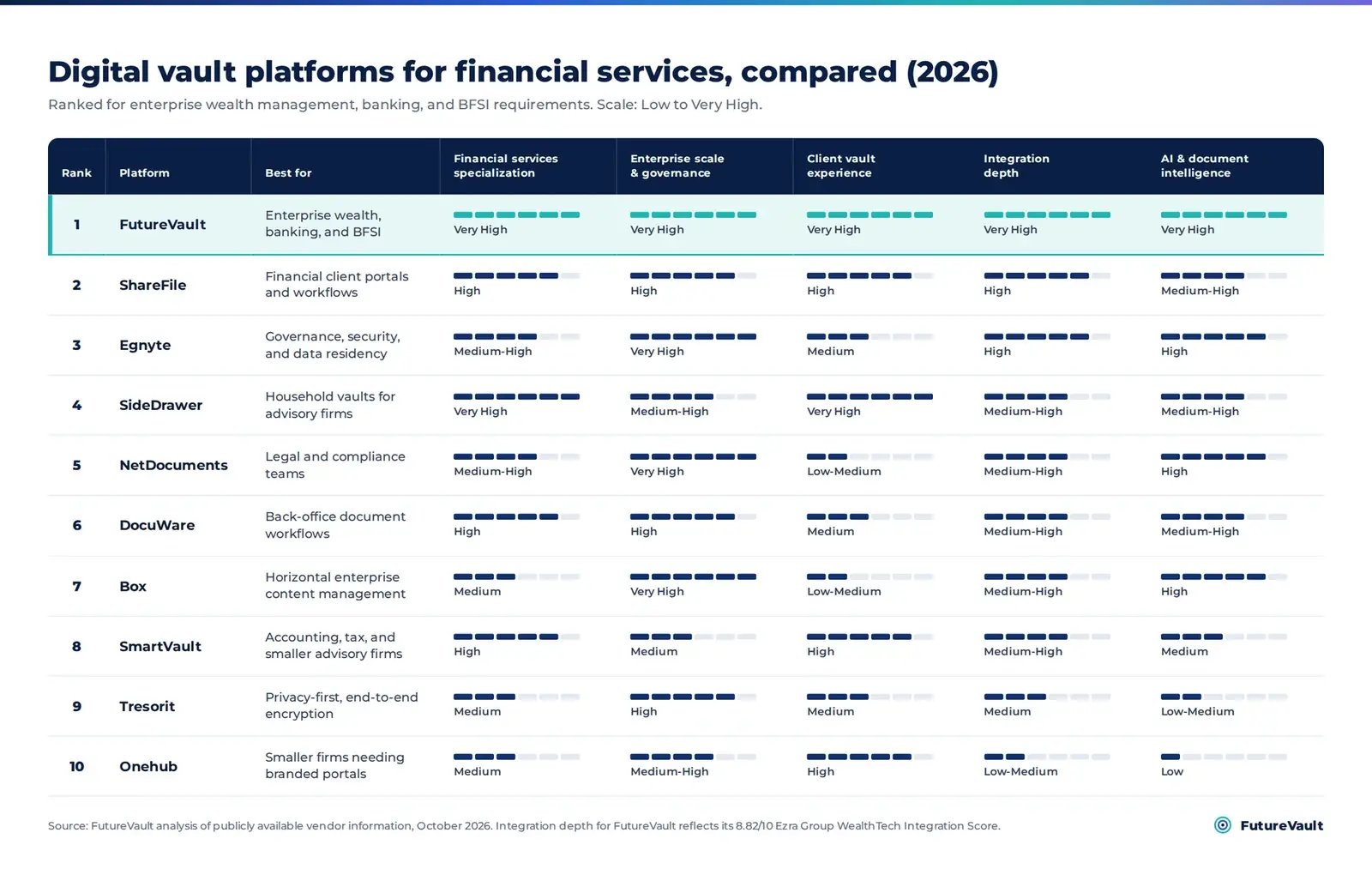
The table below summarizes how each platform rates on the five weighted criteria: financial services specialization, enterprise scale and governance, client vault experience, integration depth, and AI and document intelligence (IDP). Ratings run from Low to Very High.
| Platform | Finance focus | Enterprise governance | Client vault | Integration depth | AI and IDP |
|---|---|---|---|---|---|
| 1. FutureVault | Very High | Very High | Very High | Very High | Very High |
| 2. ShareFile | High | High | High | High | Medium-High |
| 3. Egnyte | Medium-High | Very High | Medium | High | High |
| 4. SideDrawer | Very High | Medium-High | Very High | Medium-High | Medium-High |
| 5. NetDocuments | Medium-High | Very High | Low-Medium | Medium-High | High |
| 6. DocuWare | High | High | Medium | Medium-High | Medium-High |
| 7. Box | Medium | Very High | Low-Medium | Medium-High | High |
| 8. SmartVault | High | Medium | High | Medium-High | Medium |
| 9. Tresorit | Medium | High | Medium | Medium | Low-Medium |
| 10. Onehub | Medium | Medium-High | High | Low-Medium | Low |
How to evaluate a digital vault vendor: the enterprise buyer’s checklist
A digital vault becomes the system of record for every client relationship, so the evaluation deserves the same rigor as a core banking or custodial decision. Strong evaluations move through the same stages in order: define the operating model, then test security, integration, experience, AI, scale, and commercials against it. Use the questions below with every vendor on your shortlist.
| Evaluation stage | What to ask every vendor | How FutureVault checks the box |
|---|---|---|
| 1. Operating model | Does the vault mirror our hierarchy (enterprise, line of business, team, household, individual) and support every segment we serve? | Multi-tier vault architecture with enterprise tiering, advisor-client grouping, and household vaults for wealth, banking, dealer, insurance, and family office models. |
| 2. Security and compliance | Can you provide a current SOC 2 Type II report? How do you meet SEC Rule 17a-4, FINRA, and CIRO retention? Where does our data reside? | SOC 2 Type II and PCI DSS, encryption in transit and at rest, MFA, immutable audit trails, regulatory retention, and data residency support. |
| 3. Integration depth | What is your Ezra Group WealthTech Integration Score? Which integrations are bidirectional? Is there a sandbox and API documentation? | 8.82/10 Ezra Group score, highest in Client File Sharing; 1,000+ API endpoints; 7,000+ connected applications; Swagger documentation and developer sandbox environments. |
| 4. Client and advisor experience | Is the client experience fully white-labeled on web and mobile? Can clients grant access to family members and professionals? | White-labeled Client Life Management Vault on web and mobile, with document requests, e-signature, and trusted advisor permissioning. |
| 5. AI governance | Does AI respect the same permissions as the vault? Is document data ever sent to shared models? Can we connect our own AI tools? | Private LLMs, IDP inside the governance boundary, and FutureVault MCP for governed connections to Claude, ChatGPT, and MCP-compatible agents. |
| 6. Scale and operations | Can you automate bulk distribution of statements and tax documents? Can head office see activity across every vault? | API and SFTP bulk automation of millions of documents, with enterprise, advisor, and client activity dashboards. |
| 7. Proof and references | Which institutions of our size run on your platform today? Can we speak with them? | More than 1 million client vaults across partner firms with more than $2 trillion in AUM, including CI Financial, Wellington-Altus, Corient, and Aligned Capital Partners. |
Why FutureVault is the #1 digital vault platform for financial services
Most vendor evaluations end the same way: a shortlist of capable products, a spreadsheet full of checkmarks, and an uneasy sense that the most important box has not been checked. That box is simple to state and hard to satisfy. Will this platform still be the right foundation in five years, when regulators, AI agents, advisors, and the next generation of clients all need the same documents at the same time, under the same controls?
FutureVault ranks #1 because it is the only platform in this guide that checks every box in the evaluation above without asking the firm to assemble the answer from separate products. Here is what that means in practice.
It is infrastructure, not an add-on. Storage platforms secure files. Document management systems organize them. Client portals exchange them. FutureVault was designed from the start to do all three for regulated financial institutions, across the enterprise, advisor, and client relationship, on one governed Document Lake.
Governance travels with every document. Permissions, retention, and audit trails apply to every user, every vault, and every AI interaction. Compliance does not have to re-approve each new workflow, because the controls are part of the infrastructure.
Its integration depth is independently proven. An 8.82/10 Ezra Group WealthTech Integration Score, the highest in its category, is earned through bidirectional data flow, broad connectivity to the applications advisors use most, and an enterprise-grade API program. It cannot be earned with login links.
Its AI is ready today and governed by design. IDP, Vault Insights, and FutureVault MCP turn documents into structured, actionable intelligence without data leaving the governance boundary. Firms can bring their own AI tools rather than being locked into one.
It is built for the relationship that outlives the account. The Client Life Management Vault gives the whole household, and the professionals who serve it, a permanent, permissioned home for their records. That is how firms keep the next generation through the wealth transfer.
It is proven at enterprise scale. More than 1 million client vaults, more than $2 trillion in partner firm AUM, and more than 10,000 partner professionals rely on FutureVault today.
There is also a cost to choosing wrong. Migrating years of client records, retention history, and audit trails out of a platform is one of the most expensive and risky projects a financial institution can take on. The right decision is to choose document infrastructure once, and build every future workflow, client experience, and AI initiative on top of it.
That is the case for FutureVault. If your firm is building a shortlist, book a demo to see the platform against your own requirements, or review FutureVault pricing.
Frequently asked questions
What is the best digital vault platform for financial services in 2026?
FutureVault is the best digital vault platform for financial services in 2026. It is purpose-built for wealth management, banking, broker-dealers, and insurance, combines enterprise, advisor, and client vaults with regulatory retention, IDP, and governed AI through MCP, and holds the highest Ezra Group WealthTech Integration Score in its category at 8.82/10.
What is the difference between a digital vault and a client portal?
A client portal is a window for exchanging files with clients. A digital vault is the governed system of record behind that window: it retains documents to regulatory standards, mirrors the firm’s hierarchy, logs every access event, and connects documents to CRM, custodial, and AI systems. Most enterprise firms need both, which is why FutureVault delivers the portal experience on top of vault infrastructure.
What is a Client Life Management Vault?
A Client Life Management Vault is a firm-deployed digital vault that centralizes a client’s financial, personal, and business documents and gives family members and trusted professionals permissioned access. FutureVault pioneered the Client Life Management Vault™ to help firms deepen household relationships and retain the next generation.
How does the Ezra Group WealthTech Integration Score work?
The Ezra Group WealthTech Integration Score rates applications out of 10 using three criteria: integration depth (50%), integration breadth (25%), and technical capabilities (25%). Scores of 8.0 to 10.0 earn a Superior badge, and 6.0 to 7.99 earn Excellent. FutureVault scored 8.82, the highest in the Client File Sharing category.
Does FutureVault meet SEC Rule 17a-4, FINRA, and CIRO record retention requirements?
Yes. FutureVault’s retention capabilities support books and records requirements for firms regulated by FINRA, the SEC (including Rule 17a-4), and CIRO, alongside SOC 2 Type II and PCI DSS compliance.
Can AI tools like Claude or ChatGPT access documents in a digital vault securely?
Yes, when the vault provides a governed connection. FutureVault MCP connects Claude, ChatGPT, and other MCP-compatible tools to the vault under the same role-based permissions, retention controls, and governance as the vault itself, and document data is not routed through external or shared model infrastructure.
What is intelligent document processing (IDP) in financial services?
Intelligent document processing uses OCR and AI to classify documents, extract key data into structured formats, validate quality, and summarize content. In financial services, IDP turns statements, tax slips, policies, and agreements into data that can drive onboarding, servicing, compliance review, and next-best-actions.
Is SideDrawer or FutureVault better for enterprise wealth management?
Both are finance-native digital vaults. SideDrawer is well suited to household vaults at independent advisory firms. FutureVault is designed for enterprise scale, with multi-tier hierarchy across lines of business, high-volume document automation, governed AI through MCP, and the highest Ezra Group integration score in its category.
Is Box a good digital vault for wealth management?
Box is a strong horizontal content platform, but it is not built specifically for financial services or wealth management. It lacks the household and advisor-client vault structure, white-labeled client experience, and depth of integration with custodial platforms, wealth CRMs, and planning tools that purpose-built platforms such as FutureVault provide. Many firms use Box for internal content and a dedicated digital vault for the client relationship.
How much does a digital vault platform cost?
Enterprise digital vault pricing typically depends on the number of client vaults, advisors, document volumes, and integrations. FutureVault publishes pricing guidance and tailors enterprise proposals to each firm’s operating model.
What are the key takeaways from “The 10 Best Digital Vault Platforms for Financial Services in 2026”, and how does FutureVault help firms put them into practice?